


What if the biggest mistake when investing in Dubai wasn’t choosing the wrong area, but waiting too long? The emirate’s real estate market has just recorded its highest historical price —1,840 dirhams per square foot in April 2026— and signs point to the bull cycle not having peaked yet.
The data coming from the Persian Gulf is hard to ignore: net rental yields between 6% and 10%, with no income or capital gains tax, in a city that grew 16.1% year-on-year. For the average Spanish investor, that is equivalent to recovering in three years what in Spain would take more than a decade.
Why Dubai has become the favorite destination for investors
While European markets string together interest rate hikes and tax hurdles, Dubai operates on a radically different model: zero rental tax, zero capital gains tax, and zero wealth tax. An investor who buys an apartment for 300,000 euros and sells it two years later for 420,000 euros pockets the entire 120,000 euros, without local withholding of any kind.
Added to this is the reinforced legal certainty offered by the Dubai Land Department (DLD), which has operated with full digitalization and contractual protection for foreign investors since 2022. Spain and the United Arab Emirates also have a double taxation treaty that avoids paying taxes twice for the same taxable event.
Business Bay and Dubai Marina: the two focuses of the real estate boom
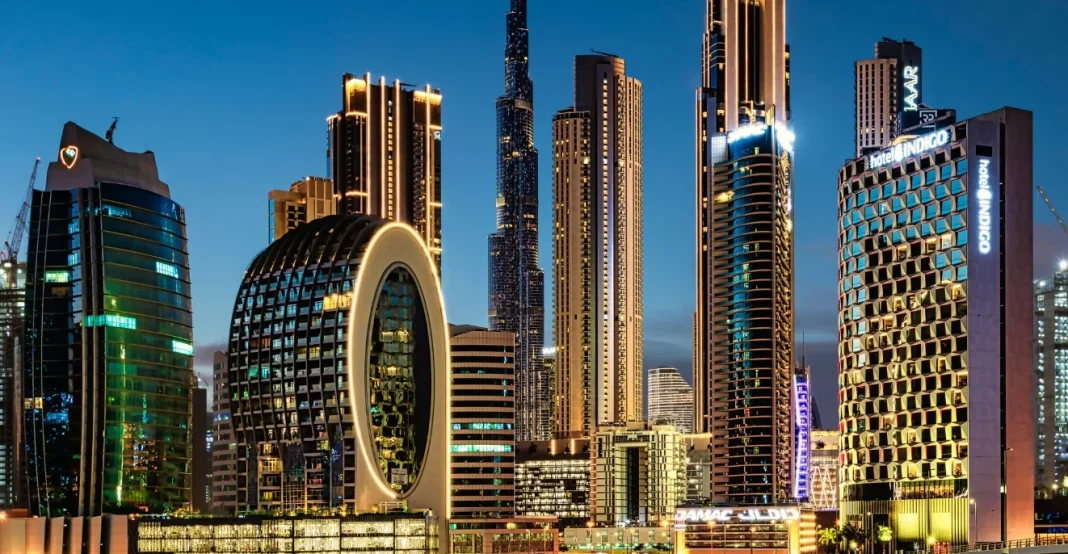
The boom in Dubai is not distributed equally in all neighborhoods. Business Bay, the expanding financial district, offers rental yields between 5.5% and 7% annually, driven by the arrival of international corporate headquarters and high-net-worth professionals. Rental demand in the area grew by 15% in the last year alone.
Dubai Marina, for its part, is the district that concentrates the highest density of luxury apartments with views of the artificial canal. The furnished monthly rentals in this area are 15% higher than those in other prime areas like Downtown, making it the most liquid option for investors looking for immediate returns via short-term rentals.
What real return you can expect in Dubai depending on the area
Not all areas of Dubai perform the same. Beyond Business Bay and the Marina, there is a wide spectrum ranging from 4.5% in Palm Jumeirah to 8.2% in emerging areas like Al Ghadeer, in the corridor between Dubai and Abu Dhabi. The key is to identify whether you are looking for long-term capital appreciation or immediate cash flow via rental.
The investor profile defines the strategy: those who enter Dubai looking for appreciation choose areas under development; those who prioritize annual return focus on consolidated areas with high tenant turnover. In both cases, the zero taxes at the local level significantly amplify the net return compared to any comparable European market.
The most frequent mistakes when buying in Dubai from Spain
The biggest risk is not the market: it is entering without knowing it. Many Spanish buyers in Dubai underestimate closing costs —around 12.5% of the property value between DLD fees, agency commissions, and VAT on services— and calculate profitability based on the purchase price without including those initial costs. The result is an inflated expectation that is not always met in the first year.
Another common mistake is not distinguishing between gross and net yield. A property in the Marina with a declared yield of 7% can end up at a real 5% once management costs, community fees, and vacancy periods are deducted. Hiring a local operator certified by the DLD is the most effective way to avoid surprises.
| Area | Rental Yield | Price Growth 2025-26 |
|---|---|---|
| Business Bay | 5.5% – 7.0% | High (financial district) |
| Dubai Marina | 6.0% – 8.0% | High (sustained demand) |
| Downtown Dubai | 5.0% – 6.5% | Moderate-high |
| Palm Jumeirah | 4.5% – 6.0% | Moderate (luxury profile) |
| Al Ghadeer | 7.75% – 8.22% | Very high (emerging area) |
The Dubai market in 2027: trends and closing advice
Analysts from Savills and Knight Frank agree that Dubai will enter a phase of more moderate growth in the second half of 2026, with annual increases of 5%-8% compared to the 16% recorded in the last financial year. That is not a warning sign: it is the natural maturity of a market transitioning from a speculative boom to a consolidated investment asset.
For the investor who is still weighing whether to take the step, the advice repeated among the most experienced operators in the emirate is always the same: do not wait for the drop that will probably not come. With a residence visa accessible from an investment of 205,000 euros, net yields exceeding 6%, and a radically favorable tax framework, Dubai remains, in 2026, the positive anomaly of the global real estate market.