

When was the last time someone said, “I’m going to Abu Dhabi to see art”? For decades, that phrase sounded almost like a joke. Today, it is a reality that makes more than one European minister of culture uncomfortable.
The emirate has spent years quietly executing a long-range cultural strategy: an entire district dedicated to art, museums designed by the most sought-after architects on the planet, and an ambition that stops at neither oil nor the desert.
Louvre Abu Dhabi, the Jewel That Changed Everything
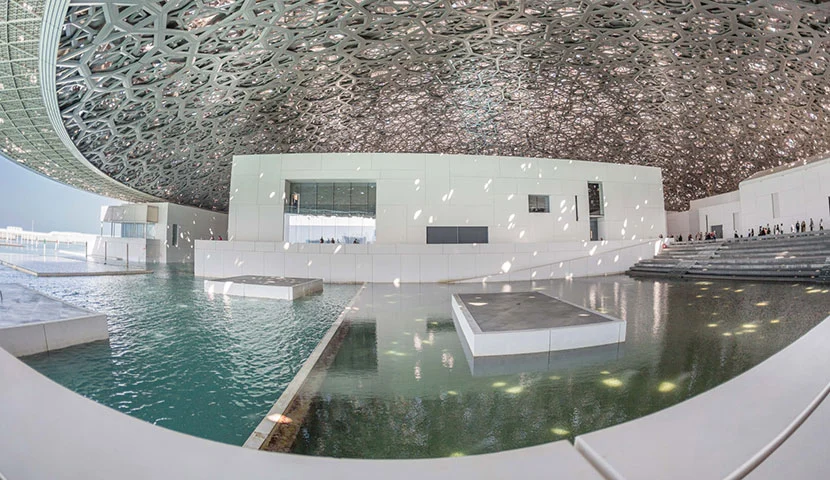
Opened in November 2017, Louvre Abu Dhabi is the first universal museum built outside of France and the only one in the Arab world. Its 180-meter perforated dome, designed by architect Jean Nouvel, filters the light from the Persian Gulf, creating what visitors call a “rain of light”—an effect no European museum can replicate.
What few know is the actual impact of that building on Abu Dhabi’s economy. Since its opening, cultural tourism in the emirate has steadily grown, and properties within a 500-meter radius of the museum have accumulated a projected 28% appreciation over three years, according to Knight Frank’s analysis.
Saadiyat Island: The Plan Shaking Europe
At the heart of Abu Dhabi beats a project that goes far beyond a single museum. Saadiyat Island—whose name in Arabic means “happiness”—already hosts five active cultural institutions in 2026: Louvre Abu Dhabi, the Zayed National Museum, the Natural History Museum Abu Dhabi, teamLab Phenomena Abu Dhabi, and Manarat Al Saadiyat.
The stated goal is to build the largest cultural district in the Arab world, an ecosystem where art, architecture, and Emirati identity coexist under a single urban project. No European capital has built anything of such scale from scratch in the last thirty years.
Abu Dhabi and the Model Europe Failed to Anticipate
Abu Dhabi’s strategy is not improvised: it is the result of decades of planned economic diversification. While the European continent debated the public funding of culture, the emirate poured sovereign resources into building institutions that would directly compete with the Louvre in Paris or the Rijksmuseum in Amsterdam.
The Culture Summit Abu Dhabi, held in April 2025 in the Saadiyat District itself, gathered global thought leaders under the theme “Culture for Humanity.” That forum did not exist ten years ago. Today, it dictates trends that European ministries study closely.
Abu Dhabi Tourism: Figures That Surprise No One Anymore
Abu Dhabi has ceased to be just the sun-and-luxury destination many imagine. Cultural tourism has become one of its main drivers for international visitors, with travelers from Spain, France, Germany, and Italy choosing the emirate specifically for its museum offerings and not just for its resorts.
On Saadiyat, each institution has a different audience profile: Louvre Abu Dhabi attracts collectors and scholars; teamLab Phenomena seduces younger generations with immersive experiences; the Zayed National Museum connects with those seeking to understand Arab identity. The segmentation of demand is highly precise and deliberate.
| Institution | Opening Year | Specialty |
|---|---|---|
| Louvre Abu Dhabi | 2017 | Universal art and history of civilizations |
| Manarat Al Saadiyat | 2009 | Local and international contemporary art |
| Zayed National Museum | 2023 | Emirati history and culture |
| teamLab Phenomena Abu Dhabi | 2024 | Immersive digital art |
| Natural History Museum Abu Dhabi | 2025 | Natural sciences and paleontology |
The Future of Abu Dhabi as a 21st-Century Cultural Capital
The Guggenheim Abu Dhabi, designed by Frank Gehry and awaiting its final inauguration on Saadiyat, will be the largest Guggenheim museum in the world when it opens. Its opening will make Abu Dhabi the only city outside New York with two globally renowned museums designed by architects of the caliber of Nouvel and Gehry in the same neighborhood.
For Spanish travelers with a cultural curiosity, Abu Dhabi is no longer an exotic option: it is a real and accessible alternative to traditional European circuits. Direct flights from Madrid, Barcelona, and other Spanish cities facilitate a trip that combines world-class art, cutting-edge architecture, and an unparalleled gastronomic and hotel offering. The desert, this time, has something to teach Europe.