

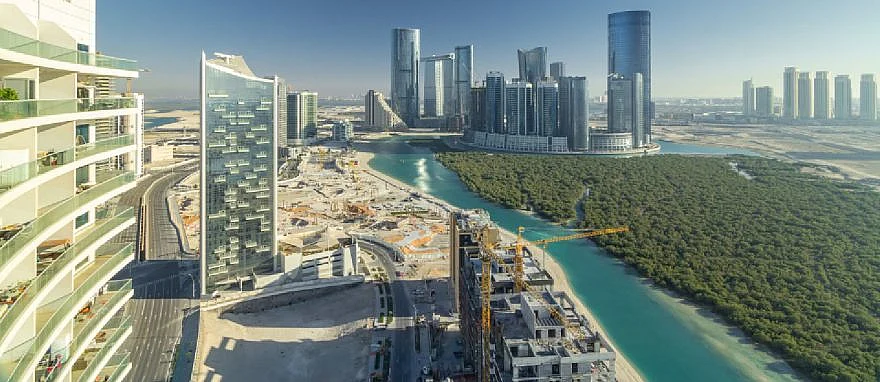
What if everything you thought you knew about Al Reem Island as an “affordable alternative to Dubai” was no longer entirely true? The island has been playing in a different league for months: prices that rose 45% in 2025, transaction volumes that tripled in a single year, and an institutional catalyst that few mainstream analyses have clearly explained.
The trigger has a name: the integration of Al Reem Island into the jurisdiction of ADGM, Abu Dhabi’s international financial centre. Since that absorption was officially completed in February 2025, residential assets in the surrounding area have responded with one of the fastest appreciations in the Gulf real estate market. The data leaves no room for interpretation.
What Is ADGM and Why Its Expansion Changes Everything
ADGM was established in 2015 as a financial free zone confined to Al Maryah Island. In 2023, the UAE Cabinet approved its territorial expansion to Al Reem Island, adding 500,000 m² of office space to its jurisdiction and reaching a combined area of 14.38 million square metres.
This is not merely a regulatory change: it is the incorporation of an entire residential island into the region’s most sophisticated legal framework — the only one in the Middle East that directly applies common law. For businesses, it means access to a globally recognised licensing structure. For homeowners, it means living within a world-class financial district.
Al Reem Island Before and After the ADGM Effect
Before the integration, Al Reem Island functioned as an upper-middle-class residential zone with competitive prices compared to other Abu Dhabi islands. It was a solid option, but without the institutional magnetism that attracts international executives and capital funds.
After absorption by ADGM, the buyer profile changed. Professionals working at global financial firms — PGIM, Franklin Templeton, and Skadden all have active offices in the district — are seeking to live minutes from their workplaces. This new demand, with high purchasing power, is what has rewritten the market figures.
The Numbers Nobody Expected on Al Reem Island
The 2025 data is concrete: transactions surged from 94,000 m² to 284,000 m², representing 24% of all real estate operations in Abu Dhabi. Al Reem Island captured 16 of the 52 new projects launched in the emirate that year. This is not a cyclical upturn; it is a structural recomposition of demand.
The average price per square foot in premium units exceeded 1,800 AED in waterfront areas, while the standard residential segment crossed 1,200–1,300 AED/sq ft. Rental yields remain at 6–7% annually, with occupancy rates above 92% according to PropertyFinder data from February 2026.
Market Comparison: Al Reem Island vs. Its Competitors
| Area | 2-bed Price (AED) | 18-month Appreciation | Rental Yield |
|---|---|---|---|
| Al Reem Island | 1,824,507 | 22–28% | 6–7% |
| Dubai Marina | 3,200,000 | 12–15% | 4–5% |
| Yas Island (Abu Dhabi) | 2,100,000 | 18–22% | 5–6% |
| Al Maryah Island | 2,600,000 | 10–14% | 4–5% |
The price gap versus Dubai Marina is still around 50%, but the appreciation gap is closing at a speed that surprises even analysts who have been following the UAE market for years. With a studio averaging 962,000 AED versus 1.5 million in Dubai Marina, the investor equation still has room to run.
Al Reem Island in 2026: Outlook and Expert Advice
Market consensus points to a moderation in the pace of price increases in 2026, but not a correction. The delivery of new developments — 12,800 units projected in Abu Dhabi for this year — could cushion upward pressure in lower-quality segments, while premium areas within the ADGM will sustain institutional demand.
The advice repeated by analysts specialising in the UAE market is always the same: on Al Reem Island, building selection and its position within the ADGM perimeter makes the difference between an asset with genuine traction and one that merely tracks the average. Buying within the already-completed district, with access to the hub’s financial services and the new bridge connecting to Saadiyat Cultural District, is the variable that professional investors are weighing today.