

While half the world assumed logistics in the Persian Gulf had collapsed, Dubai was moving containers. On March 1, 2026, Iranian drones and missiles hit the international airport, the Burj Al Arab hotel, and caused a fire at one of the berths in its main port. Four days later, operator DP World issued an unambiguous statement: all terminals are operating normally.
What is happening at Jebel Ali Port is not just a logistics news item. It is the clearest signal that Dubai has decided its economic engine cannot stop, even in the middle of an unprecedented military escalation in the region. The question is how it has managed it and what this implies for the thousands of companies that depend on this supply chain.
The blow Dubai received and did not admit
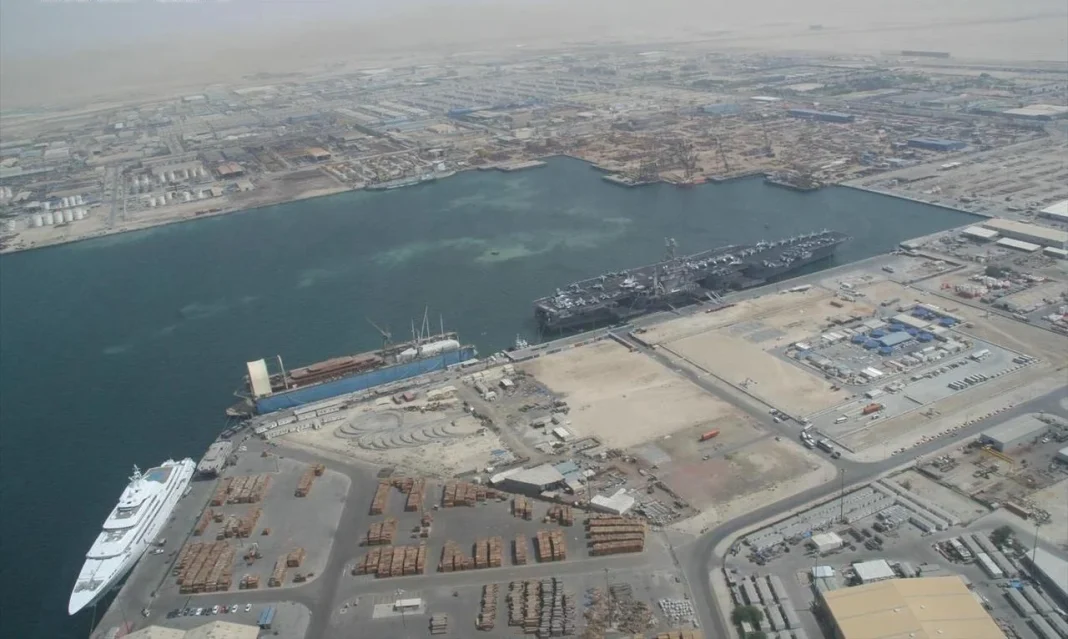
In the early hours of March 1, Emirati air defense systems intercepted projectiles over the Jebel Ali area. One of the port berths caught fire. Images circulated on social media within minutes, and many international logistics operators activated their contingency protocols.
What did not spread as quickly was the key figure: the fire was brought under control within a few hours, and no container terminal was taken offline. DP World confirmed that maritime traffic suffered no interruptions. The gap between the headlines and the operational reality was enormous.
Dubai and its bet on continuity at any cost
The port of Jebel Ali generates about 60% of Dubai’s revenues and is the world’s largest artificial port. With four terminals and a capacity of more than 15 million TEUs annually, a prolonged disruption would have consequences far beyond the borders of the Emirates.
DP World immediately deployed enhanced security measures across all facilities. The company maintains direct coordination with local authorities, and the Emirati government has made it clear that port operability is a red line that will not be negotiated under any military scenario.
The Strait of Hormuz closes, Dubai does not
The context is decisive. The partial closure of the Strait of Hormuz, through which about 20% of the world’s oil flows, has spiked volatility in energy markets and disrupted dozens of global maritime routes. In that scenario, Jebel Ali’s operability becomes a rare and strategic asset.
Dubai acts as a gateway between Asia, Europe, and Africa. Every day that the port keeps operating while other routes are compromised, it strengthens its position as an indispensable logistics hub. That is precisely the narrative international operators are processing this week.
What the numbers say that Dubai has not wanted to hide
| Indicator | Data |
|---|---|
| Annual capacity Jebel Ali | +15 million TEU |
| Contribution to Dubai’s revenues | ~60% |
| Number of operational terminals | 4 of 4 |
| Days from the attacks until normalization | 3-4 days |
| World oil passing through Hormuz | ~20% |
| Injuries in the Emirates after the attacks (day 7) | 112 |
The table needs no comment: while the Strait of Hormuz has faced its greatest pressure in decades, Jebel Ali has kept four terminals open and cargo flow uninterrupted.
Dubai as a logistics benchmark: what to expect in the coming weeks
The resilience shown in these days will have long‑term commercial consequences. Companies that were diversifying their routes to reduce exposure to the Gulf will find in Dubai a strong argument not to do so, or at least to keep Jebel Ali as the main node.
The advice circulating among international logistics analysts is clear: anyone operating in the region should monitor the Strait of Hormuz, but continue to rely on the port of Dubai as the most stable entry point in the Gulf. The story of these days is backed by data, not promises.