


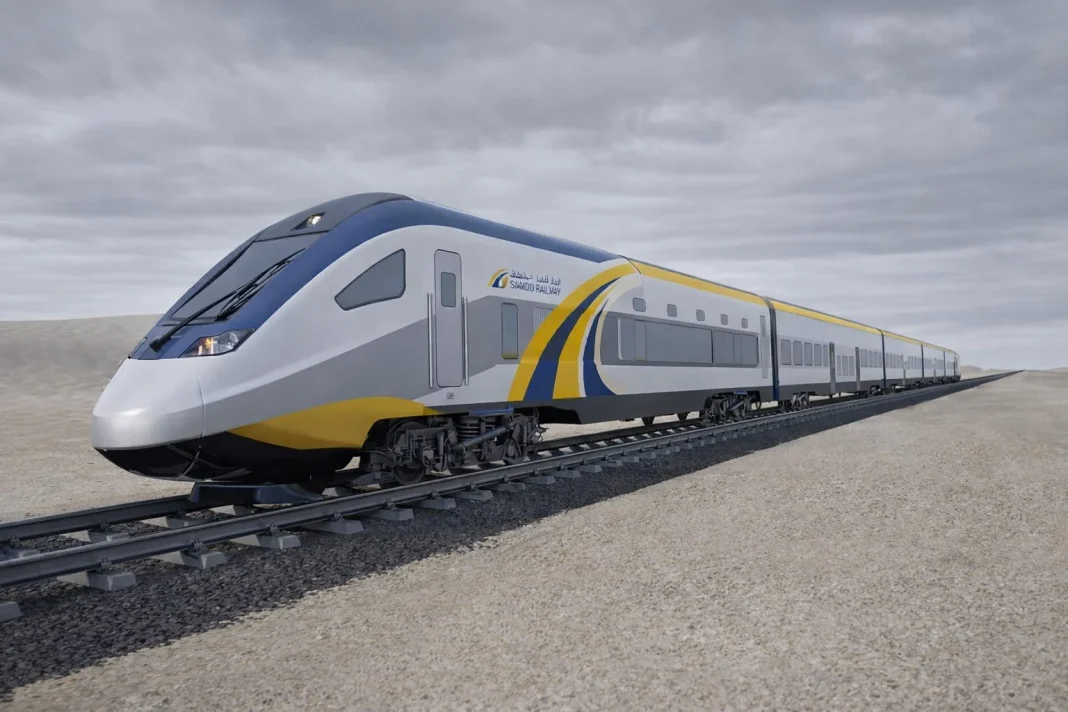
There are countries that take decades to lay down their first passenger tracks. The United Arab Emirates has done it in less than a decade, and this year 2026, the trains of the Etihad Rail project will begin rolling between Dubai and Abu Dhabi, the two most populous cities in the federation. The journey, which currently requires nearly two hours by car with traffic, will be reduced to less than an hour by train. It is, probably, the most radical mobility change the Gulf region has experienced in generations.
What makes this project even more striking is the context in which it was born: a country with no passenger rail tradition, with ground temperatures exceeding 60 °C in summer, sandstorms covering the tracks in minutes, and sandy terrain that forced the design of specific foundations for every kilometer of the route. That Etihad Rail is about to inaugurate its service is not just transportation news: it is a story of extreme engineering.
Etihad Rail and the date that skeptics didn’t think possible
The Etihad Rail project confirmed in 2025 the launch of its first passenger routes for this 2026, with three initial connections: Abu Dhabi, Dubai, and Fujairah. The corridor between the first two cities will have daily frequencies designed for both commuting and inter-emirate tourism. The 13 trains of the fleet have already arrived in the country, and ten of them have completed certification testing.
Each convoy has a capacity for more than 400 passengers, runs at up to 200 km/h, and is equipped with full Wi-Fi, individual power outlets, and advanced acoustic insulation. It is no ordinary train: the Spanish company CAF is responsible for manufacturing and maintaining the entire fleet, which represents a milestone for the Spanish railway industry in Middle Eastern markets.
Etihad Rail, the Emirates, and a network looking beyond 2026
Etihad Rail is not just the train between Dubai and Abu Dhabi: it is the backbone of a plan that will connect eleven cities across the seven Emirates, from Al Sila to Fujairah, passing through Sharjah, Ras Al Khaimah, and Al Ain. Official projections estimate 36.5 million annual passengers by 2030, a figure that would make it one of the railway networks with the highest traffic per capita in the Arab world.
Beyond national borders, Etihad Rail is part of the ambitious GCC Railway, the megaproject that plans to connect the six countries of the Gulf Cooperation Council—Saudi Arabia, UAE, Qatar, Kuwait, Bahrain, and Oman—by train with an estimated investment of $100 billion. When complete, it will be possible to travel by train from Muscat to Kuwait, covering nearly 2,000 kilometers that are currently only accessible by road or plane.
What changes for those who live and travel in the Emirates
For those who work in Dubai and live in Abu Dhabi—or vice versa—, Etihad Rail completely transforms the day-to-day calculus. Today, that journey involves facing the E11 highway with standard traffic; from 2026, it will mean sitting in a carriage, connecting to Wi-Fi, and arriving in less than an hour. Businesses are already anticipating an operational improvement: moving teams predictably and punctually is a key factor in high-intensity business environments like those characterizing both cities.
For tourism, the impact is no less significant. A visitor in Dubai will be able to discover Abu Dhabi’s cultural offerings on the same day without relying on a rental car. The stations are designed as urban hubs with direct access to local metros and taxis, making door-to-door travel truly competitive against private vehicles.
The technical challenges that no one had solved before
Building in the hottest desert
Laying 900 kilometers of track in an environment where the ground reaches 60 °C in summer and where sandstorms are unpredictable demanded unprecedented engineering solutions. The sections crossing moving dune zones required terrain stabilization systems that do not exist in any European railway manual. The investment in the 256 km section between Abu Dhabi and Dubai alone exceeded $13.6 billion, according to data from Saipem, one of the construction companies involved.
A fleet certified under European standards
That Etihad Rail has chosen CAF—a Basque company based in Beasain—to manufacture and maintain its trains is no coincidence. European safety and comfort standards were a requirement from the very beginning of the project. Ten of the thirteen convoys have already passed certification testing in the Emirates, and the remaining three are in the final validation phase before the start of commercial service.
Etihad Rail in 2026: four keys to the launch
- Three initial routes: Abu Dhabi–Dubai, Dubai–Fujairah, and Abu Dhabi–Fujairah operational in the first phase.
- Trains manufactured in Spain: the Basque company CAF supplies and maintains the 13 convoys of the fleet.
- Maximum speed of 200 km/h on the conventional network; up to 350 km/h on the future high-speed line between Abu Dhabi and Dubai.
- First completed station: Fujairah, with 51,900 m² in the Madinat Al Hilal neighborhood, 12 minutes from the international airport.
The future of transport in the Emirates has steel wheels
Etihad Rail is the clearest symbol of the transformation that mobility is undergoing in the Emirates: a country that built its image on cars and planes is now betting on the train as an engine of sustainable connectivity. The 30% to 40% reduction in travel times—and the drastic reduction in emissions compared to road transport—makes it a project with a real impact on the quality of life for millions of people.
The coming years will tell if Etihad Rail meets its demand figures and if the model can be replicated in other Gulf countries. But the direction is already clear: in a region that for decades built eight-lane highways, the railway has just started its engines.