

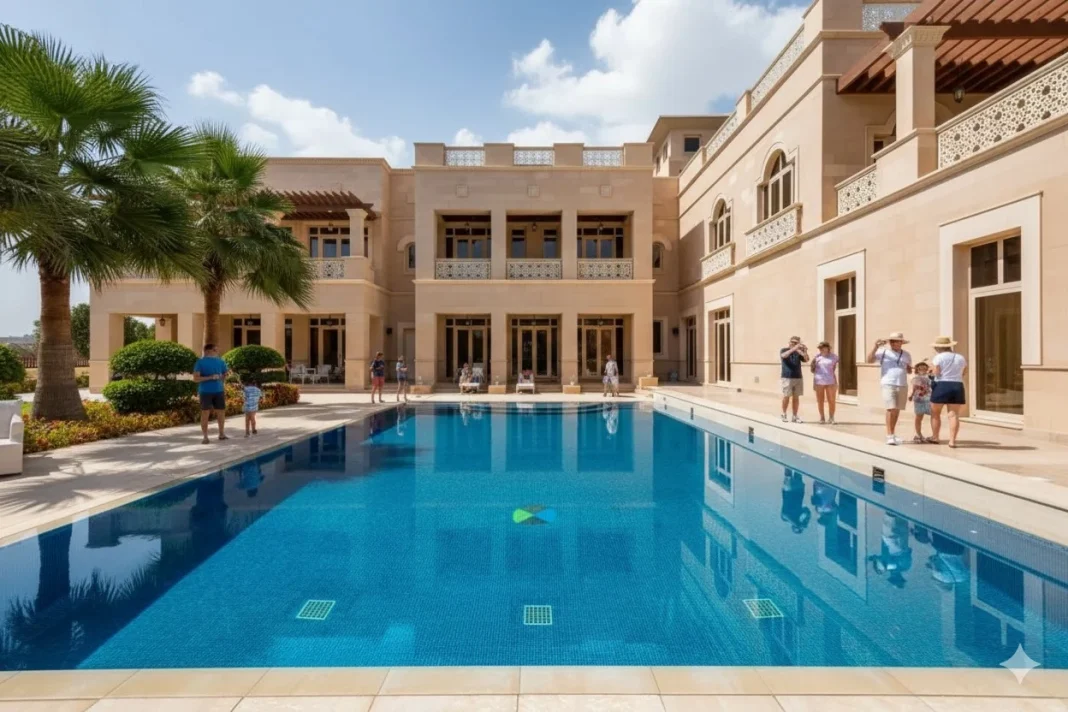
Does it make sense to pay more for a postal address than for the building on top of it? In Emirates Hills, the answer has been a resounding yes for more than two decades: Dubai’s most experienced real estate agents repeat that the real value is not in the villa, but in the plot where it stands. When steel tycoon Lakshmi Mittal acquired a baroque mansion in this enclave for around AED 425 million in 2025, he didn’t just buy bricks: he bought the last available address in what the market recognizes as Dubai’s old money neighborhood.
What is striking is not that prices are high, but that they keep rising with zero new stock. Emirates Hills has been without untouched plots for years; everything hitting the market consists of secondary properties changing hands at record figures. This structural scarcity is precisely the engine that turns every transaction into global news.
Emirates Hills: the Beverly Hills that surpassed its inspiration
Emirates Hills was born in 2003 as the first freehold community open to foreigners of any nationality in the United Arab Emirates. Emaar Properties designed its 641 villas around two golf courses —Montgomerie and Emirates Golf Club— with plots ranging between 1,100 and over 4,600 square meters, under the premise that no house would look like its neighbor’s. The result was an enclave where luxury is measured in privacy and land, not in height.
Today, plots overlooking the golf course reach prices between $545 and over $1,000 per square foot, and the most expensive villa sold in the first half of 2025 —The Marble Palace, originally listed for AED 750 million— closed at AED 425 million. Local brokers are honest: even with an unlimited budget, there might be nothing available. Scarcity is part of the appeal.
Emirates Hills and Dubai Hills Estate: two models, the same magnet for capital
In January 2026, the daughter of Formula 1 tycoon Petra Ecclestone acquired a residence in Emirates Hills valued at around $70 million, facing the golf course on a 2,500-square-meter plot. A few kilometers away, Dubai Hills Estate —also developed by Emaar, within Mohammed Bin Rashid City— recorded a 16.5% year-on-year increase in the average residential price in February 2026, with Fairway Vistas series mansions ranging between AED 27 million and AED 45 million.
The difference between the two communities lies in the concept: Emirates Hills is the consolidated enclave, with no possibility of new construction, where land is worth more than any structure. Dubai Hills Estate, on the other hand, is an actively expanding master-planned city —with its own golf course, hospital, shopping malls, and international schools— attracting families and investors who prioritize long-term infrastructure over pure status. Two luxury philosophies that, far from competing, feed into each other.
Why the ultra-rich choose Dubai over London or Singapore
The United Arab Emirates attracted nearly 9,800 new millionaires in 2025, more than any other country in the world according to consultancy firm Henley & Partners. This influx is no coincidence: the absence of income tax, ten-year residency visas for investments exceeding AED two million, and a world-class infrastructure make Dubai the preferred fiscal and residential destination for family offices, crypto-entrepreneurs, and major industrial fortunes from Europe, Asia, and Latin America.
The market for properties above AED ten million grew by 62.7% in the first half of 2025 compared to the previous year, with more than 3,700 transactions in that price range. The message from the data is clear: the ultra-luxury segment has ceased to be a niche and has become the central axis of Dubai’s real estate identity.
Land price: the variable that explains everything
| Zone | Average price per sqm (2026) | Annual variation |
|---|---|---|
| Emirates Hills (golf plots) | From $5,900 | No new plots |
| Dubai Hills Estate (villas) | From $3,200 | +16.5% YoY |
| Palm Jumeirah (villas) | From $4,500 | +12% YoY |
The table illustrates a paradox: Emirates Hills trades at a higher premium precisely because it doesn’t grow. The absence of new supply turns every square meter into an almost unrepeatable asset, whereas Dubai Hills Estate combines sustained appreciation with real liquidity —a higher number of transactions and a wider variety of buyers. Analysts point out that waterfront or golf-front plots in Dubai Hills Estate will replicate, over the next decade, the same scarcity cycle that Emirates Hills is already experiencing.
Trends 2026-2030: Where is elite capital heading in Dubai?
Dubai’s ultra-luxury market is undergoing a significant restructuring. Projects like Emaar’s The Oasis —nine million square meters of mansions built over artificial canals in southern Dubai— aim to capture buyers who would have opted for Emirates Hills five years ago, but today look for integrated home automation and waterfront living that the established neighborhood cannot offer. Far from posing a threat to Emirates Hills, this dynamic confirms that Dubai has room for multiple layers of exclusivity.
For the investor or buyer analyzing these markets from Spain, the key lies in understanding that luxury in Dubai is not bought just in square meters: it is bought in scarcity, privacy, and community. Emirates Hills represents the mature model; Dubai Hills Estate, the maturing one. Those arriving at Dubai Hills Estate today might find themselves late to Emirates Hills in ten years, and the appreciation data from the past thirty-six months strongly suggests so.