

The sleeping giant of the Gulf has finally awakened from its lethargy with a force that has shaken the foundations of the international real estate market. After years of speculation and standstills, Palm Jebel Ali emerges as the big bet by Nakheel to surpass its own architectural limits. This revival is not just a feat of engineering, but a clear statement of intent: Dubai has no ceiling and its expansion into the sea has just begun its most aggressive chapter.
What years ago seemed like an abandoned sand skeleton is now rapidly transforming into the new object of desire for investors from half the world. While the old palm is reaching saturation, this new artificial archipelago promises to double the offer of exclusivity with a much more modern and sustainable approach. Palm Jebel Ali does not arrive simply to complement its smaller sister, but to completely eclipse it in magnitude, features, and vision of the future.
TWICE THE SIZE, TWICE THE AMBITION
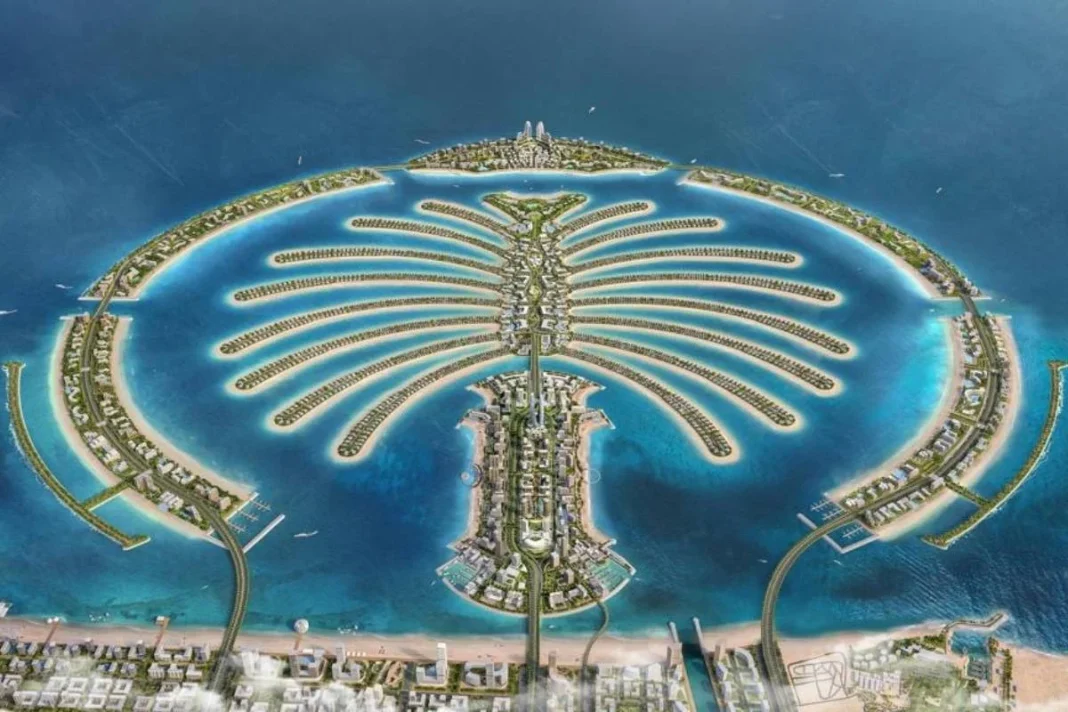
Comparisons are often unwelcome, but in this case they are absolutely necessary to understand the monumental scale of what is taking shape in the emirate’s waters. If Palm Jumeirah already seemed immense, it must be noted that Palm Jebel Ali doubles the total surface area of the original island, reaching 13.4 square kilometers of land reclaimed from the sea. We are talking about adding 110 kilometers of additional coastline to Dubai, a dizzying figure that will help relieve pressure on the current beach areas.
The spatial layout of this new titan has been rethought to correct the density issues of the past, offering far more breathing room between the “branches” of the palm. Planners have understood that the true luxury is space and privacy, so the distances between the fronds will be much greater. Palm Jebel Ali is thus presented not as a copy, but as a sophisticated evolution that prioritizes visual openness and direct connection with the marine environment.
LESS CONCRETE, MORE EXCLUSIVE VILLAS
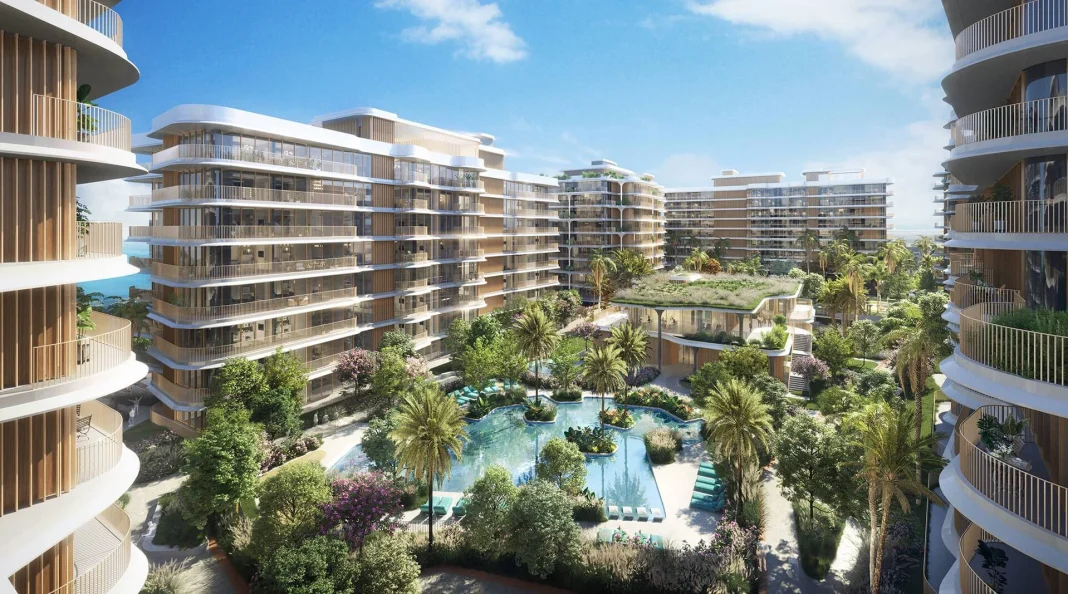
Unlike its predecessor, which ended up being packed with numerous apartment blocks along the trunk, the current master plan opts for a much more pronounced and elitist horizontality. The commercial strategy is clear, as ultra-luxury single-family villas will be prioritized over the large residential towers that crowd the skyline. It is estimated that this new development will host around 80 hotel and resort facilities, while maintaining a “low-density” aesthetic that resembles the Maldives more than a vertical metropolis.
The properties already on the market, known as Beach Collection and Coral Collection, have triggered a true frenzy among billionaires seeking a private retreat with direct beach access. The design of these mansions is radically modern, as the architecture seeks to blur the boundaries between indoors and outdoors through the extensive use of glass and open spaces. In Palm Jebel Ali, the home is not just a roof, but a privileged viewpoint that merges with the blue horizon of the Persian Gulf.
ENGINEERING IN THE SERVICE OF SUSTAINABILITY
Building an island of this size in the 21st century requires meeting environmental standards that did not exist two decades ago. Engineers are applying cutting-edge technologies, since the technical challenge includes the efficient management of tides to ensure that water circulates freely between the fronds and does not stagnate. Palm Jebel Ali will integrate “smart city” systems from the ground up, ensuring that residents’ energy consumption is far more efficient than in any other development in the region.
The commitment to the environment is also reflected in the promise to source up to 30% of the required energy from renewables and in the creation of vast green areas that will act as natural lungs. It is not just about pouring concrete, but about creating a living ecosystem where sustainability becomes a fundamental pillar of the overall urban plan. This green approach is crucial to attracting an increasingly aware international buyer who demands that their investment in Palm Jebel Ali be environmentally responsible.
KEY PIECE IN THE DUBAI 2040 PLAN
This project is not an isolated mushroom that has sprung up out of nowhere, but a master piece within the great puzzle that is the Master Urban Plan of Dubai 2040. The authorities know that, in order to sustain population and tourism growth, it is vital that urban development expands southwards, connecting to the Jebel Ali port area and the new airport. Palm Jebel Ali functions as the anchor of a new center of gravity for the city, shifting interest from the traditional downtown to this new southern “Riviera”.
The reactivation of the project has injected renewed optimism into the local economy, attracting foreign capital that views Emirati real estate as a safe haven amid global instability. Analysts agree that this megaproject will act as an economic engine capable of generating thousands of jobs and attracting ultra high net worth tourism. With Palm Jebel Ali, the emirate secures its dominant position on the global luxury stage for the next two decades.
A LIFESTYLE WITHOUT PRECEDENT
Living on this new island will mean accessing a level of services and amenities that is hard to replicate on the mainland or in older developments. Residents will have access to beach clubs, marinas, and wellness centers, as the leisure offering will be integrated into the community itself so there is no need to leave the island. Palm Jebel Ali is conceived as a city within the city, a self-sufficient microcosm where urban stress disappears the moment you cross the access bridge.
The resounding success of the first sales phases shows that the appetite for this type of exclusive product remains intact and that the Dubai brand continues to be magnetic. Those who arrive in time to secure a slice of this artificial paradise will not only be purchasing square meters, but will own a piece of modern history of engineering and urban planning. Palm Jebel Ali is not just sand and sea; it is the tangible proof that when human imagination has the necessary resources, it knows no physical limits.