

Jumeirah Islands represents much more than a collection of luxury villas in the middle of the desert; it is the materialization of an economic strategy as brilliant as it is counterintuitive in a city obsessed with vertical opulence. In an environment where “more is more” seems to be the motto, this community demonstrates that its true value lies in a bold strategy of planned scarcity, creating an oasis of tranquility and a fortress for investment. Can you imagine a place that protects itself from real estate crises simply by how it was designed from its origin?
This exclusive artificial archipelago does not need physical walls to maintain its status, as its defense is much more subtle and powerful: an invisible “economic moat” that isolates it from market volatility. The question is not what Jumeirah Islands has, but what it deliberately lacks, because the low building density acts as an invisible wall against the oversupply that affects other areas. Keep reading and discover the secret that turns this corner of exclusivity into a unique case study in the world.
BEYOND THE SKYSCRAPERS: AN UNEXPECTED OASIS
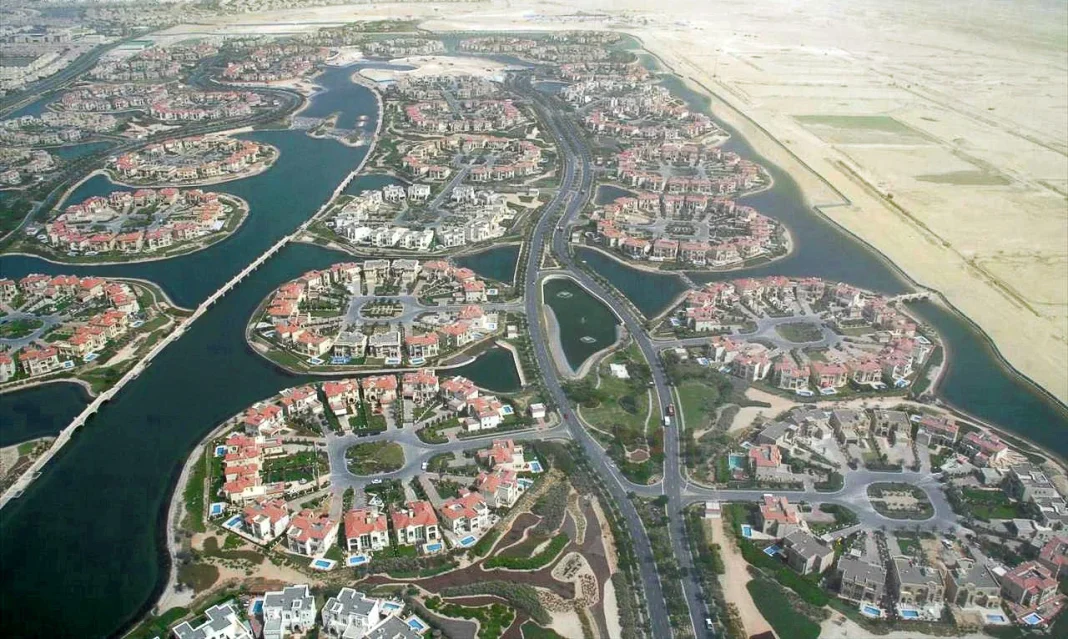
When flying over Dubai, the view is saturated with skyscrapers that scrape the clouds, an architectural race to touch the sky that defines the city’s global image. However, when one looks towards Jumeirah Islands, the landscape changes radically, offering an almost miraculous visual respite. This development by Nakheel Properties is a deliberate counterpoint, where true wealth is manifested in horizontality, space, and privacy, elements that are the ultimate luxury in such a densely populated metropolis.
Far from the incessant hustle and bustle of the city center, life in this luxury community unfolds at a different pace, marked by the serenity of its saltwater lakes and the lushness of its vegetation. It is a world apart, a reminder that exclusivity does not always shout from the heights. Sometimes it whispers in the breeze that blows through the private gardens, as Jumeirah Islands’ design prioritizes quality of life over population density, a decision that today shields the value of each of its properties.
THE ARCHITECTURE OF SELECTIVE ISOLATION
Whoever planned this place was not just drawing houses, but sculpting an economic and social microclimate. It is a modern fortress where the walls are water and the entrance gate is a very specific status. Exploring the map of Jumeirah Islands reveals the genius of its conception: a cluster of 46 interconnected islands housing just over 700 villas. This proportion is the key to everything, as the extremely limited supply of homes generates constant and highly selective demand, ensuring that property values do not get diluted in a market prone to expansion cycles.
The structure of this gated community in Dubai creates a sense of isolation that is both physical and psychological, a factor that attracts a clientele seeking a safe haven for their assets and families. It is not just a place to live; it is a statement of intent. By investing in this exclusive area, one acquires a tangible asset whose scarcity is guaranteed by design, because the impossibility of expanding the number of villas protects owners from depreciation, an almost perfect shield against the construction ambition that defines the rest of the city.
WHAT DOES “LOW DENSITY” REALLY MEAN IN REAL ESTATE?
In the real estate lexicon, “low density” may sound like a cold and distant concept, but its implications are deeply human and economically powerful. It means larger gardens, greater distance between neighbors, and above all, a sense of peace that money can rarely buy in large cities. In the context of Jumeirah Islands, this factor is the pillar of its business model, because low density translates directly into a greater perception of exclusivity and well-being, two of the most sought-after intangible assets in the luxury market.
This characteristic is the engine that drives the “economic moat” that gives this reflection its title. While other projects in Dubai compete to maximize the number of sellable units per square meter, Jumeirah Islands took the opposite approach. Potential short-term sales volume was sacrificed to build something much more enduring: a reputation for stability and long-term appreciation that attracts smart investors, who understand that true luxury is not what can be added, but what does not need to be removed.
THE PSYCHOLOGICAL EFFECT: “IF THERE’S LITTLE, IT’S WORTH MORE”
The human mind is wired to desire what is difficult to obtain, a principle as old as trade that this neighborhood masterfully exploits. The strategy behind Jumeirah Islands appeals to one of the most basic levers of consumer psychology: the principle of scarcity. What is rare, limited, and not accessible to everyone is automatically perceived as more valuable. This mechanism is universal, but in the luxury sector it becomes a tool of immense power. By living in Jumeirah Islands, residents not only enjoy a home, but the certainty of belonging to a very select club, a status factor that fuels desire and sustains prices.
This perception is not an illusion; it has very real consequences on market behavior. Potential buyers see not only bricks and gardens, but an investment opportunity that feels secure and prestigious. The aura of controlled unattainability that surrounds the Jumeirah Islands acts as a magnet for global capital, as planned scarcity creates a self-perpetuating cycle of desire and appreciation, turning each villa into both a residential and financial trophy. Demand remains high precisely because the supply remains artificially low.
JUMEIRAH ISLANDS, THE INVESTMENT THAT PROTECTS ITSELF
At the end of the day, the success of Jumeirah Islands lies not in its luxurious finishes or the beauty of its canals, but in its quiet resistance to fads and construction frenzies. It is an ecosystem designed to endure, a place where investment is intrinsically protected by the very concept that gave it life. This exclusive community demonstrates with facts that true economic sustainability in the high-end real estate sector comes from discipline and long-term vision, not from the pursuit of quick and massive profits.
As Dubai continues to reinvent itself and launch increasingly spectacular projects, the quiet value of Jumeirah Islands remains, almost unperturbed. Its residents and investors sleep soundly, knowing that the most important asset of their property is not the marble on the floor or the lake views. In this oasis by Nakheel, the greatest luxury is the certainty that the empty space surrounding you is your best guardian, an invisible yet insurmountable barrier that protects your assets today and will continue to do so tomorrow.