


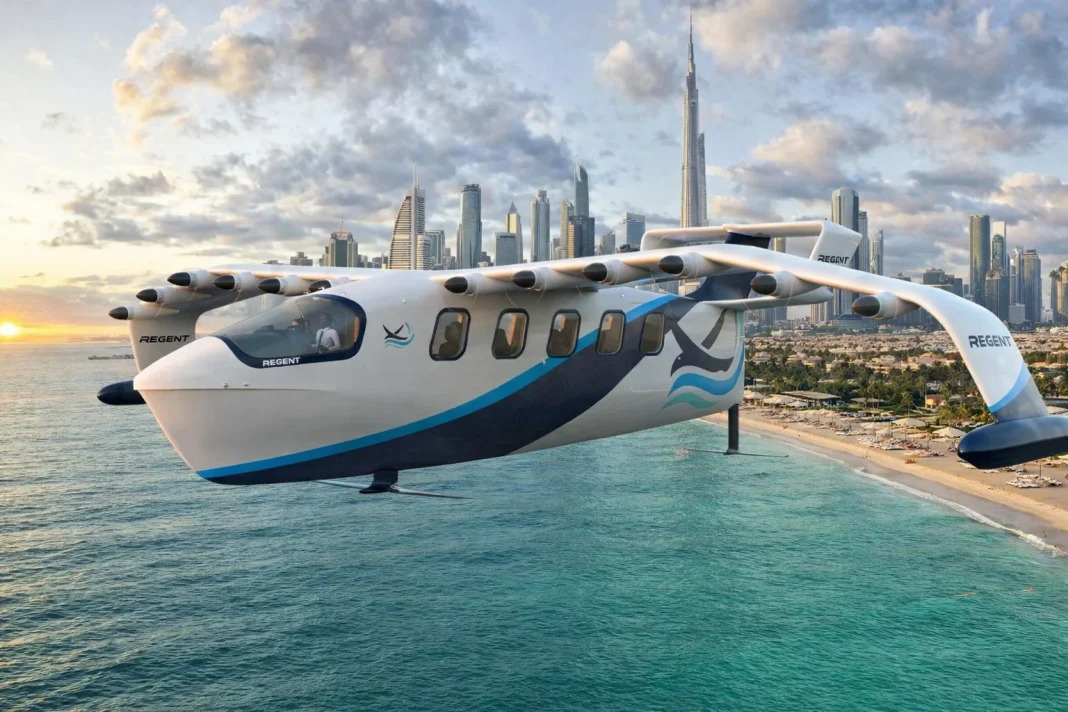
Can a desert emirate become a global pioneer in the maritime transport of the future? Abu Dhabi is not just promising it: it is building it with real contracts, public investment, and technology that until recently only existed in renders. The announcement is significant: ADNOC Logistics & Services, the logistics arm of Abu Dhabi’s state oil company, has sealed an alliance with the US manufacturer REGENT to introduce electric seagliders into its operations. Additionally, the emirate’s Department of Municipalities and Transport is already working to integrate this technology into the public transport network.
Abu Dhabi Bets on the Seaglider as the Transport of the Future
The seaglider is neither a boat nor a plane: it is an electric vessel that sails a few meters above the water’s surface by taking advantage of the ground effect, allowing it to reach speeds of up to 290 km/h with zero emissions. In Abu Dhabi, this technology is not an academic experiment; it is a strategic bet backed by the emirate’s largest energy producer.
In April 2024, REGENT signed two key agreements in Abu Dhabi: one with the Abu Dhabi Investment Office (ADIO) to develop local manufacturing capabilities, and another with the Department of Transport to study the integration of the seaglider into the emirate’s public network. Two years later, those agreements already have a schedule and funding.
What Exactly Is the Seaglider Arriving in Abu Dhabi
The model chosen for Abu Dhabi is the Viceroy, REGENT’s first operational design. It has a capacity for 12 passengers or 1,600 kg of payload, operates on a fully electric battery, and offers travel times equivalent to a helicopter but with an operating cost up to 80% lower. Compared to traditional transfer vessels, it is more than 70% faster.
The technology on which the seaglider is based—known as “wing in ground effect” or aerodynamic ground effect—allows the craft to fly just a few meters above the water without technically detaching from the sea surface, classifying it as a naval vessel rather than an aircraft. This greatly simplifies its regulation and integration into the ports of Abu Dhabi, which already has compatible port infrastructure.
Planned Routes and Operations in the Emirate
The first confirmed use of the seaglider in Abu Dhabi will be the transfer of ADNOC workers to offshore platforms in the Persian Gulf. Currently, this journey is made by helicopter or conventional boat; with the seaglider, travel time is drastically reduced, and the carbon footprint of each trip is eliminated, which is key to Abu Dhabi’s sustainability goals for 2030.
Beyond industrial use, the Abu Dhabi Department of Transport is working on coastal passenger routes that would connect strategic points of the emirate by sea at speeds never before seen in commercial naval transport. The seaglider would use the same existing docks without the need for new infrastructure, which greatly reduces implementation costs and accelerates timelines.
Why Abu Dhabi Leads This Technology Worldwide
It is no coincidence that Abu Dhabi and not another city in the world is leading the global deployment of the seaglider. The emirate combines three unique factors: a coastal geography with dozens of islands and offshore infrastructure, an institutional appetite for transport innovation, and a financing capacity backed by the planet’s largest sovereign wealth fund, with assets exceeding $875 billion.
| Feature | Seaglider Viceroy | Conventional Helicopter | Transfer Vessel |
|---|---|---|---|
| Top Speed | 290 km/h | 280 km/h | ~40 km/h |
| Emissions | Zero (Electric) | High (Fossil Fuel) | Medium-High |
| Operating Cost | Up to 80% lower | Base Reference | Lower than helicopter |
| Capacity | 12 passengers / 1,600 kg | 6-12 passengers | 20-50 passengers |
| Required Infrastructure | Existing docks | Specific helipads | Existing docks |
The Seaglider Horizon in Abu Dhabi: 2027 and Beyond
The first operational seagliders in Abu Dhabi are planned for 2027, with a full coastal route expansion by 2028. By then, the emirate expects to have established the regulatory framework that will serve as a model for other Gulf countries and the world. The bet is not marginal: it is part of the economic diversification strategy that already places non-oil sectors at more than 54% of Abu Dhabi’s GDP.
For travelers and professionals with connections to the Persian Gulf, the advice is clear: Abu Dhabi is not improvising this technological leap. Every agreement signed, every institutional collaboration, and every euro of investment suggests that the seaglider is not a promise but the next chapter of global transport, and this emirate will be the first to write it.