

Can a desert city become the new world capital of art in less than a decade? Abu Dhabi has spent years answering that question with concrete, glass, and million-dollar collections, and in 2025 it delivered the definitive answer: the simultaneous opening of three major museums in the same year, something unprecedented in the recent history of cultural tourism.
The autumn of 2025 was the turning point. The Abu Dhabi Natural History Museum opened on November 22, the Zayed National Museum did so in December, and tickets sold out for weeks. Abu Dhabi is no longer competing with European cities: it surpasses them in investment, in scale, and increasingly in actual visitor numbers.
Abu Dhabi Inaugurates a New Era of International Cultural Tourism
Since 2017, when the Louvre Abu Dhabi opened on the sands of Saadiyat, Abu Dhabi has been quietly building the most ambitious cultural infrastructure in the Arab world. Eight years later, that project reached maturity with a concentration of institutions that no city on the planet can match in such a small geographic space.
The Abu Dhabi Department of Culture and Tourism projects receiving 39.3 million annual visitors by 2030, up from 24 million in 2023. Cultural tourism is not a complement to that figure: it is its main driver, and Saadiyat is the engine of that engine.
Saadiyat, the Island Abu Dhabi Turned into the Capital of Art
The project began on an island whose name in Arabic means “the island of happiness.” Few names proved so prophetic. Abu Dhabi transformed Saadiyat from a nearly empty enclave into a 2,700-hectare cultural district where five world-class museums, a Berklee music school, and the immersive art space TeamLab Phenomena now coexist.
What sets Saadiyat apart from other cultural districts — such as London’s South Bank or Berlin’s Museumsinsel — is the strategic coherence of its design. Each institution was conceived to dialogue with the others: the Universal Louvre with the Arab heritage of the Zayed National Museum, and the planetary science of the Natural History Museum with the contemporary art of the future Guggenheim Abu Dhabi.
Five Museums That Redefine the Cultured Traveler’s Experience
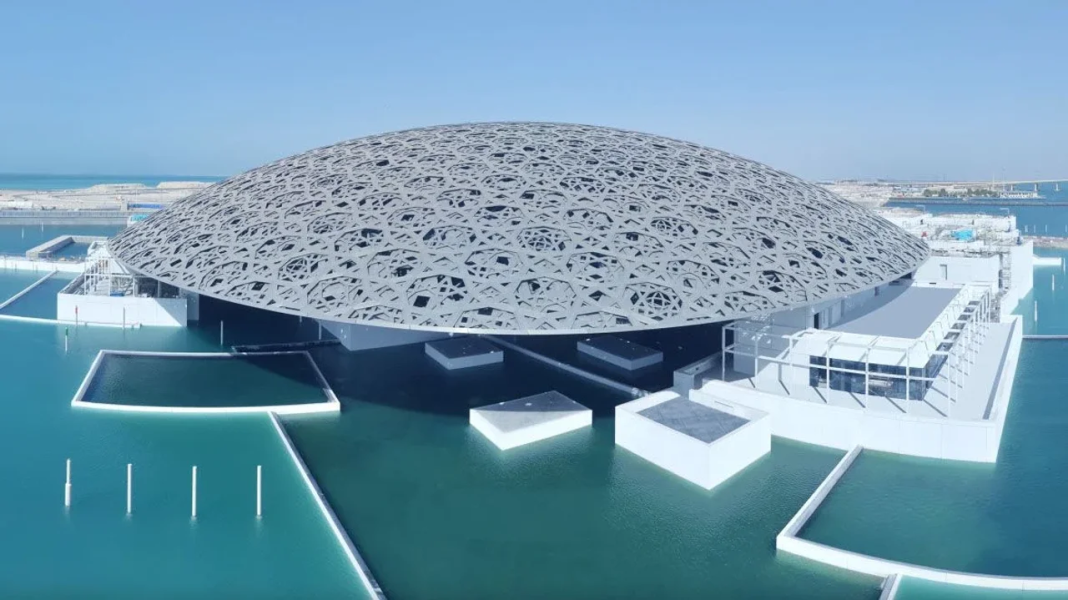
The Louvre Abu Dhabi remains the emblem: its dome perforated by Jean Nouvel filters sunlight over 23 galleries with more than 600 works of art from cross-cultural collections, and since 2017 has welcomed more than 5 million people. Beside it, the newly inaugurated Zayed National Museum offers a collection of unique artifacts that narrate the history of the Emirates from antiquity to the founding of the modern nation.
The Abu Dhabi Natural History Museum is, by contrast, an experience that transcends contemplation: a journey of 13.8 billion years from the Big Bang to the present that transforms the visit into something close to a total sensory experience. Alongside them, TeamLab Phenomena and the upcoming Guggenheim Abu Dhabi round out a catalog that already surpasses many European capitals in variety.
The Figures That Demonstrate the Real Impact on Abu Dhabi
Abu Dhabi tourism generated a 2025 target of AED 62 billion — around $16 billion — in economic contribution, 13% more than in 2024. Hotel occupancy in the city approached 82% as early as the first quarter of the year, a figure that would have seemed implausible five years ago for a city that historically lived in Dubai’s shadow.
Saadiyat is the strongest argument for that transformation. The staggered opening of museums generated a cumulative attraction effect: each new inauguration reactivated media interest in the previous ones, creating a visibility cycle that fueled Abu Dhabi tourism for consecutive months.
| Institution | Opening Year | Key Fact |
|---|---|---|
| Louvre Abu Dhabi | 2017 | +5 million cumulative visitors |
| TeamLab Phenomena Abu Dhabi | 2025 | First opening of the year on Saadiyat |
| Abu Dhabi Natural History Museum | Nov. 2025 | Journey of 13.8B years through the universe |
| Zayed National Museum | Dec. 2025 | UAE national museum, Foster + Partners |
| Guggenheim Abu Dhabi | 2026 (planned) | Contemporary art from the 1960s onward |
Abu Dhabi in 2026: The Cultural Destination That Can Still Surprise
The Guggenheim Abu Dhabi, designed by Frank Gehry, is planned for 2026 and will be, when it opens, the definitive catalyst for the district’s tourist maturity. Sector experts point out that its inauguration could trigger a new demand cycle similar to the one Bilbao experienced with the Guggenheim effect in the nineties, but backed by the financial and logistical support of a state investing more than $10 billion in tourist infrastructure through 2030.
For the Spanish traveler planning their next cultural destination, Abu Dhabi today offers what Paris or Amsterdam took decades to build. Saadiyat Island is not a promise of the future: it is, since 2025, a visitable, coherent, and extraordinary reality that deserves a place on the agenda of any art lover who takes their travels seriously.