

Does it still make sense to look at Palm Jumeirah when the market itself signals that the peak profitability cycle has already passed? Dubai Islands, the new five-island archipelago developed off the shores of Deira, is attracting exactly the capital that once flowed toward the world’s most famous palm — and it’s doing so with an advantage Palm Jumeirah can no longer offer: entry price at the initial phase.
The data speaks for itself. Resale units within Dubai Islands are trading today above Nakheel’s official launch price, meaning early buyers are already accumulating capital appreciation before receiving their keys. The pattern replicates exactly what happened in the 2021–2023 cycle, when early buyers captured gains of between 25% and 50% before handover.
Why Dubai Islands Is Outperforming Palm Jumeirah in Investor Appeal
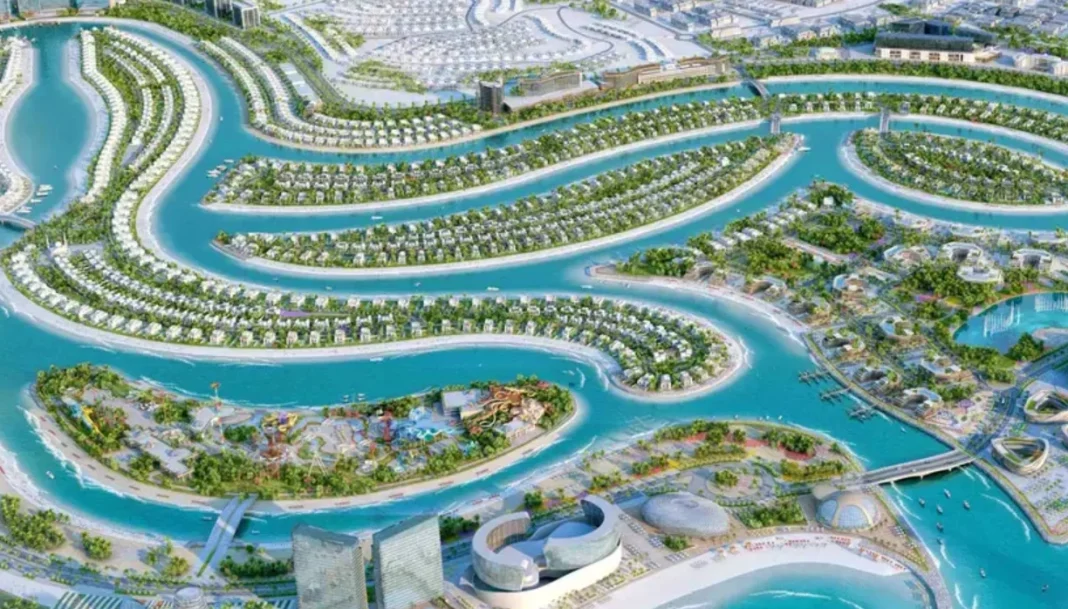
The key is controlled density. Palm Jumeirah carries decades of development, with mature but saturated infrastructure and prices that already fully discount the exclusivity premium. Dubai Islands sits at the opposite end of the spectrum: five islands spanning 17 square kilometers, designed from scratch with low residential density, private beaches, and a green space ratio that Palm Jumeirah can structurally never match.
The smart investor’s argument is not emotional — it’s mathematical. Palm Jumeirah today takes 23% longer to sell its waterfront properties than two years ago, according to market data from late 2025. Meanwhile, Dubai Islands recorded sales growth of over 40% in 2025, positioning itself as one of the markets with the greatest appreciation potential for 2026 according to leading sector analysts.
The Nakheel Project Defining Dubai Islands Pricing
The Dubai Islands portfolio today revolves around residential projects by Nakheel, the same developer that built Palm Jumeirah and is now staking its reputation on this new archipelago. Bay Villas, Bay Grove Residences, and Rixos Residences are the flagship developments: 3 to 6-bedroom villas with beachfront access, prices starting from AED 1.85 million for apartments and up to AED 47 million for luxury beach villas.
The installment payment plan offered by Nakheel — 15% on booking, 65% during construction, and 20% on handover — allows investors to leverage capital in an asset that appreciates while it is being built. This mechanism, structural to Dubai’s market, is precisely what makes off-plan investment in Dubai Islands a more capital-efficient operation than buying in the secondary market with the asset already delivered.
The Exclusivity Bet: Private Beaches and Low Density as Differentiating Assets
Capital seeking exclusivity has a chronic problem: when it finds the ideal destination, it overcrowds it. Palm Jumeirah is the perfect example of that cycle. Dubai Islands has learned from that mistake, and its urban planning explicitly limits residential density per island, reserving wide stretches of coastline for controlled public use and for private beaches tied to residences.
The project encompasses more than 20 kilometers of new beachfront — including Blue Flag-certified beaches — distributed across five islands, with 9 marinas and capacity for 1,300 vessels. This is not marketing: it is infrastructure that directly prices into the cost per square meter as the development phase matures, exactly as happened in Palm Jumeirah between 2005 and 2015.
Real Numbers: What the Spanish Investor Can Expect from Dubai Islands
The return profile of Dubai Islands for 2026 combines two return streams that rarely coexist in a single asset. The first is rental ROI, estimated at a net 8–9% per year for properties in this area, with zero income tax or capital gains tax — zero, by legal mandate in the United Arab Emirates. The second is capital appreciation, which analysts project in a range of 20–30% before handover for those entering off-plan during 2026.
Spanish investors in particular have an entry window in Dubai Islands that is closing: Nakheel’s early-stage projects still offer price-per-square-meter levels well below what equivalent units command in Palm Jumeirah or Emaar Beachfront. That price gap, combined with the developer’s track record and the Dubai government’s backing through the 2040 Urban Master Plan, is the central argument for acting before the market fully prices in the expected appreciation.
| Area | Entry Price (approx.) | Estimated Net ROI 2026 | Risk Profile |
|---|---|---|---|
| Palm Jumeirah | From $800,000 USD | 5–6% | Low |
| Emaar Beachfront | From $450,000 USD | 7–10% | Medium-High |
| Palm Jebel Ali | From $500,000 USD | 7–10% | Medium-High |
| Dubai Islands | From $350,000 USD | 8–9% | Medium |
| Jumeirah Village Circle | From $110,000 USD | 8–8.5% | Low |
Dubai Islands in 2027: What the Market Is Already Pricing In
Forecasts for Dubai Islands on the 2027 horizon are not built on optimism, but on work already underway. Nakheel’s first residential projects have handover dates in Q4 2027, and the hotel infrastructure — with chains such as Rixos and RIU already committed — guarantees that the destination will have a critical mass of visitors and residents when keys change hands. That is the moment that historically triggers secondary market prices in Nakheel developments.
The advice from any analyst with experience in Dubai’s real estate cycle is always the same: the money is made during the construction phase, not after handover. Dubai Islands is exactly there: an archipelago that already exists physically, with a proven developer, verifiable infrastructure, and growing international demand every quarter. The projected 25% appreciation window is not an advertising promise; it is the logical consequence of buying before the market completes its valuation of the asset.