

What if the most impressive thing Dubai has to offer is no longer in the sea, but in the desert? For decades, the Gulf city built its image on water: artificial islands, seaside skyscrapers, luxury private beaches. But in February 2026, Sheikh Mohammed bin Rashid Al Maktoum signed a project that changes everything.
The Al Layan Oasis is not an island, not a tower, and not a shopping mall. It is a million-square-meter environmental destination approved with an investment of $1.08 billion, designed to attract 330,000 visitors a year. Dubai has just reinvented itself, and this time it is doing so by looking towards the desert.
Dubai Bets on the Desert: What is the Al Layan Oasis
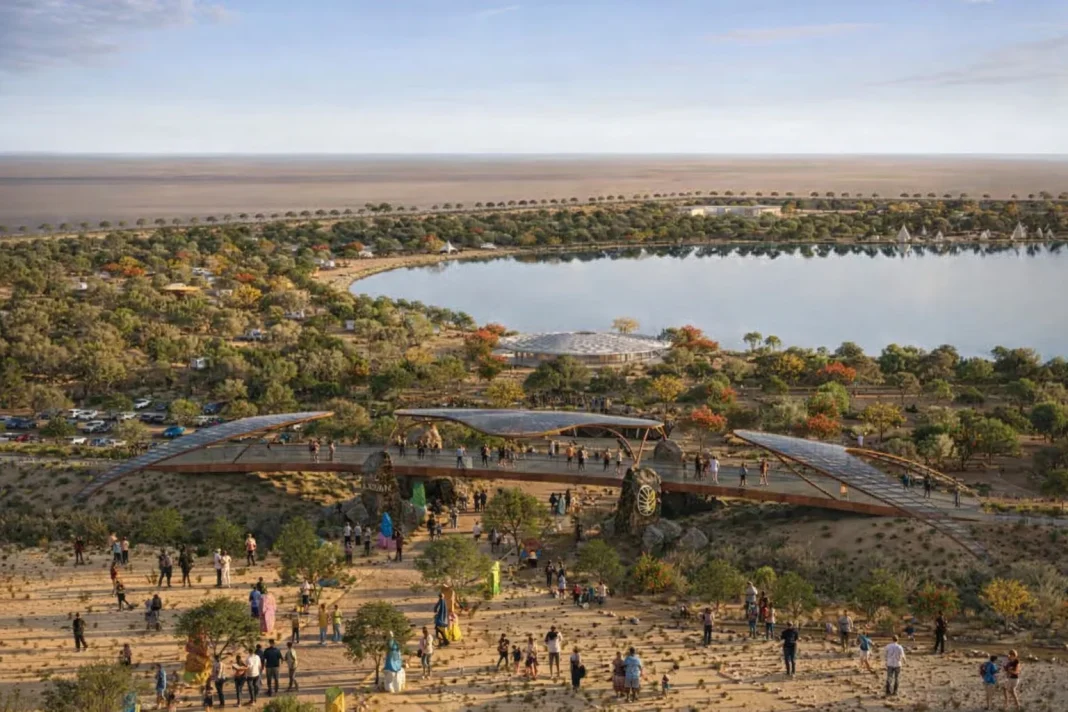
The Al Layan Oasis is located in the Al Marmoom district, a nature reserve south of Dubai already known for its ecological richness. The project pivots around an artificial lake of more than 250,000 square meters, surrounded by trails, recreational areas, and caravan camping zones. There are no skyscrapers, no casino: there is nature designed with precision.
The initiative is part of Dubai’s Blue and Green Roadmap 2030, which mobilizes more than 4 billion dirhams in quality-of-life projects. The Director General of the Municipality, Marwan Ahmed bin Ghalita, defined it as “a milestone in creating human-centered natural environments.” Dubai, the city that built islands in the sea, is now building oases in the sand.
Dubai vs. Palm Jumeirah: The Paradigm Shift No One Saw Coming
When Dubai inaugurated the Palm Jumeirah in the mid-2000s, the message was clear: money, spectacle, and the future were in the sea. The palm island became synonymous with absolute luxury, featuring five-star hotels, multi-million dollar villas, and the Atlantis as a global icon. For nearly twenty years, that model was untouchable.
But the market has been sending different signals for months. The new developments generating the best performance in Dubai are precisely those that offer space, nature, and sustainability over the density of traditional islands. The Al Layan Oasis does not compete with Palm Jumeirah in luxury: it competes in purpose, and that is exactly what the 2026 traveler and investor are looking for.
What You Will Find Inside the Emirate’s Most Ambitious Oasis
The project divides its territory into thematic zones with different functions. There is a Gathering Oasis with an outdoor cinema, amphitheater, and food truck spaces. A Family Oasis with 28 resting areas and play zones. And a camping area with capacity for 100 caravans, something completely unprecedented in Dubai.
The 14 kilometers of walking and cycling trails include 4 km of elevated walkways five meters high, offering spectacular views of the artificial lake and the surrounding desert. Dubai stops being just a showcase and becomes an experience lived from within.
Why the Al Layan Oasis Also Interests Spanish Investors
Dubai’s real estate market grew by 20% year-on-year in 2025, with a historic record of transactions and a 27% increase in monetary value. In this context, new sustainable developments lead the appreciation, with projection of appreciation exceeding 8% annually in emerging areas compared to the historical 5-6% of enclaves like Palm Jumeirah.
For the Spanish investor, Dubai remains a market free of rental income taxes and with access to interest-free payment plans. The Al Layan Oasis is not just a park: it is the catalyst for a premium residential area under development, which in investment terms means entering before the price reflects the maturity of the destination.
| Indicator | Palm Jumeirah | Al Layan / New Developments |
|---|---|---|
| Estimated annual appreciation | 5-6% | 8-9% |
| Development profile | Mature and consolidated | Emerging and expanding |
| Attraction model | Coastal luxury | Ecotourism and nature |
| Projected visitors/year | +4,000 residential properties | 330,000 visitors |
| Strategic framework | Nakheel / decades operational | Green Roadmap 2030 |
The Future of Dubai Features Sand, Not Just Water
Projections for the coming years in Dubai point to increasingly segmented tourism: while Palm Jumeirah will remain the destination for extreme luxury and global recognition, new poles of attraction like the Al Layan Oasis will capture a traveler profile seeking authenticity, well-being, and contact with the emirate’s natural environment.
The advice from any Gulf market expert would be the same today: don’t wait for the oasis to be finished to discover it. Dubai has an unwritten rule that is systematically fulfilled: projects that seem strange at first end up being the most coveted on the market. The Al Layan Oasis is no exception; it is the new norm.