

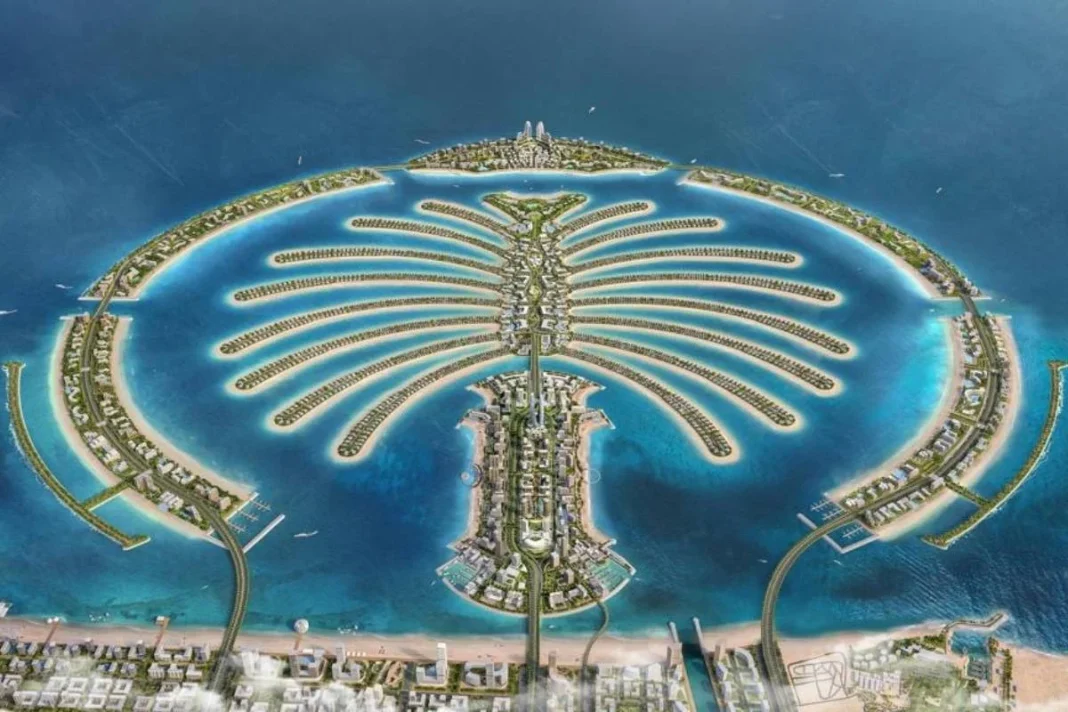
Palm Jebel Ali is being revived after 16 years of dormancy with a proposition that challenges the logic of Dubai’s real estate market. Nakheel, the state-backed developer behind Palm Jumeirah, has confirmed the launch of 2,002 villas distributed across 16 themed fronds, with prices starting at 18 million dirhams for five-bedroom units. This 13-square-kilometre development adds 110 kilometres of new coastline to the emirate, doubling the footprint of its iconic predecessor.
The project marks the transition from architectural promise to tangible reality with contracts awarded worth 5 billion dirhams for core infrastructure. However, the valuation equation raises questions that no investor should overlook. The lower population density and larger space per unit contrast with a location further from the city’s financial and commercial core, sparking a technical debate over whether the current price differential accurately reflects these variables or anticipates a future convergence with Palm Jumeirah values.
Density comparison: 2,002 villas versus 10,000 inhabitants
Palm Jumeirah is home to more than 10,000 permanent residents spread across 4,000 residential units including apartments, penthouses and villas. The saturation of common areas and shared infrastructure has generated recurring criticism about congestion at access points, private beaches and basic services during peak seasons. The high-density model maximised return per square metre for Nakheel but diluted the experience of exclusivity that initially positioned the project as a global benchmark.
Palm Jebel Ali flips this equation with 2,002 villas spread across a territory more than twice as large. The ratio of inhabitants per square kilometre is drastically reduced, offering greater privacy, less pressure on shared services and less congested common areas. Each themed frond will function as an independent neighbourhood with its own architectural identity, avoiding the visual homogenisation that characterises some sectors of its predecessor.
Price structure: AED 18–42 million depending on configuration
The price range confirmed by Nakheel sets a floor of 18 million dirhams for five-bedroom villas on standard fronds, climbing to 42.6 million for seven-bedroom units in prime locations facing the Arabian Gulf. This positioning replicates the launch strategy that Palm Jebel Ali originally employed with Palm Jumeirah in 2004, when entry prices allowed buyers to get in before the speculative boom.
The direct comparison with the secondary market on Palm Jumeirah shows price convergence in the entry segments. Five-bedroom villas in Jumeirah range between 22 and 28 million dirhams depending on condition and specific location on the palm. The initial advantage in favour of Palm Jebel Ali stands between 15–35% depending on the specific comparison, not so much due to a structural discount as to the advantages of buying in the primary market: brand-new units, developer guarantees and no immediate renovation costs.
Strategic location: logistics advantages versus distance from the centre
✓ Proximity to Jebel Ali Port, the largest logistics hub in the Middle East
✓ Direct access to the future expansion of Al Maktoum International Airport
✓ Connection to the JAFZA free zone and strategic industrial corridors
✓ Development of the new urban centre of gravity towards the south of Dubai
✓ Lower road congestion compared with Sheikh Zayed Road at peak hours
The location 18 kilometres further south than Palm Jumeirah is at once the main competitive advantage and the biggest drag on valuation. Technical analysis requires distinguishing between end-user buyer profile versus speculative investor. For permanent residents working in the free zone or port area, proximity translates into quantifiable savings in commuting time. For investors focused on holiday rental yields, the distance adds commercial friction compared with options better connected to Downtown and Dubai Marina.
Infrastructure and timelines: technical validation in Q4 2026
Nakheel has awarded contracts worth 5 billion dirhams with scheduled completion of core infrastructure in the fourth quarter of 2026. This milestone marks the transition from promise to physical reality: excavation completed, utility installation underway and the first foundation slab poured in January 2026 according to official updates. The progress validates the initial roadmap but does not guarantee on-time delivery of individual villas, whose construction depends on subcontractors and global supply chains.
The collective memory of Dubai’s real estate sector still bears the scars of the 2009 crisis, when the original Palm Jebel Ali was frozen alongside dozens of megaprojects. Direct government backing through Nakheel —a state-owned company— provides a stronger structural guarantee than private developers, but does not eliminate timeline and cost-escalation risks. Buyers of villas scheduled for delivery between 2028 and 2029 are exposed to macroeconomic and construction variables over a three-year horizon.