

90 minutes from Abu Dhabi, in the heart of the world’s largest desert, a resort emerges like a golden fortress. The Qasr Al Sarab by Anantara stands in the middle of the Empty Quarter, an ocean of sand covering 650,000 square kilometers that crosses Saudi Arabia, Yemen, Oman and the Emirates. Its walls and towers evoke centuries-old Arab palaces, but within beats five-star technology and comfort.
This complex achieved international fame when it served as the base for filming both Dune movies. For this reason, director Denis Villeneuve and his team chose these dunes to bring the planet Arrakis to life. For nearly a month, actors and technicians turned the resort into their home while filming in the immensity of the Rub al-Jali.
Cinematic base on planet Arrakis
The Empty Quarter is the world’s largest continuous sand desert. For the production of Dune: Part Two, this setting proved perfect due to its endless dunes and virgin landscapes. However, the logistics were monumental.
During 27 days of filming, the entire cast along with 300 local technicians, 250 international staff and 500 extras stayed at the Qasr Al Sarab. Furthermore, cinematographer Greig Fraser took advantage of natural light at sunrise and sunset to capture the most epic scenes. The first film used this setting for five days in 2019, but the sequel multiplied the team’s presence in the region.
The filming temporarily transformed the resort into a film production city. In this way, the complex demonstrated its capacity to host large-scale operations in the middle of the world’s most hostile desert.
Palatial luxury among golden dunes
The resort features infrastructure designed for extreme comfort. On the other hand, each accommodation offers panoramic views of the fire-colored dunes surrounding the complex. The architecture evokes traditional Arab palaces with local materials and contemporary design.
The facilities include these distinctive elements:
- 140 rooms and 14 suites with luxury Arab decoration
- 51 villas with private pools isolated from the main building
- Separate Royal Pavilion with personalized host service
- Spa with Moroccan hammam treatments and desert rose
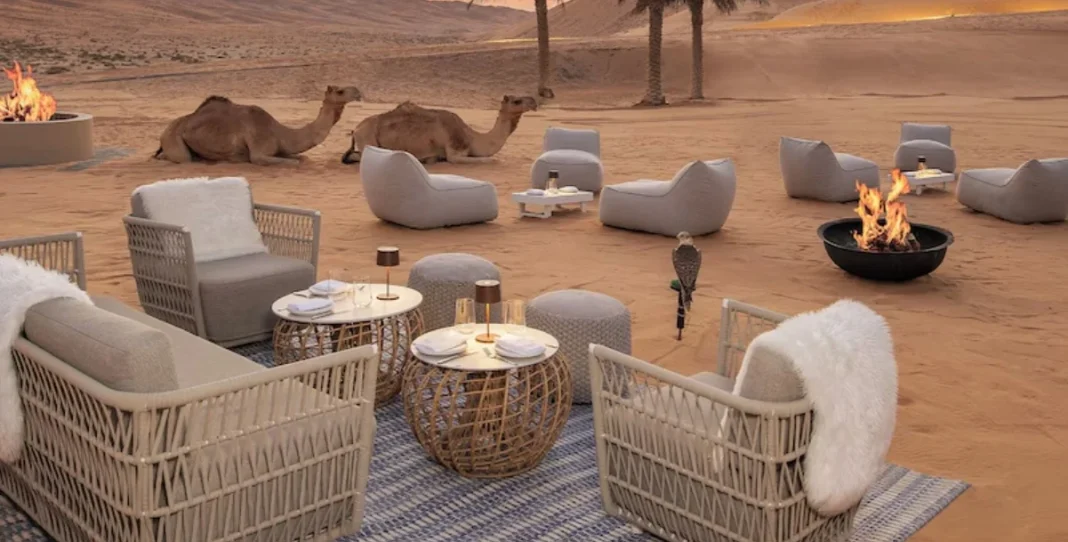
- Restaurants with gastronomic experiences under the stars
The most exclusive villas are located separately from the central building. Additionally, they offer total privacy with individual pools and terraces oriented toward the desert. Guests can organize private dinners among the dunes or enjoy camel rides at sunrise.
Ideal winter season for the desert
Between November and March, the Empty Quarter experiences optimal climatic conditions for tourism. Daytime temperatures range between 20°C and 28°C, far removed from summer’s 50°C. For this reason, this period makes Qasr Al Sarab a premium destination for those seeking to experience the desert without extreme heat.
The hyperarid climate of the region barely registers 25 liters of annual precipitation. However, this guarantees clear skies virtually year-round. Cool nights allow outdoor activities such as stargazing without light pollution.
The access road to the resort extends 12 kilometers between golden dunes before reaching the complex. Furthermore, the journey offers spectacular views from the very first moment. The contrast between luxury and absolute aridity creates a unique sensory experience that combines genuine adventure with high-level comfort.
Total isolation in the Empty Quarter
Qasr Al Sarab is located in the Fawa oasis, near the southern border of the United Arab Emirates. This area is so inhospitable that even Bedouins historically ventured to explore it. In fact, the first documented Western explorations occurred in 1931 and 1932, when Bertram Thomas and St John Philby partially mapped the region.
The complex’s name means “Palace of Mirages” in Arabic. On the other hand, it refers to the common optical phenomenon when heat creates visual illusions on the horizon. Geologically, the Rub al-Jali is one of the regions richest in oil in the world, with centers like Shaybah operating among the sands.
Today, the resort represents one of the few controlled access points to this extreme territory. Complete isolation, with no other constructions for kilometers around, makes it a refuge for those seeking total disconnection in an environment of extreme luxury.