

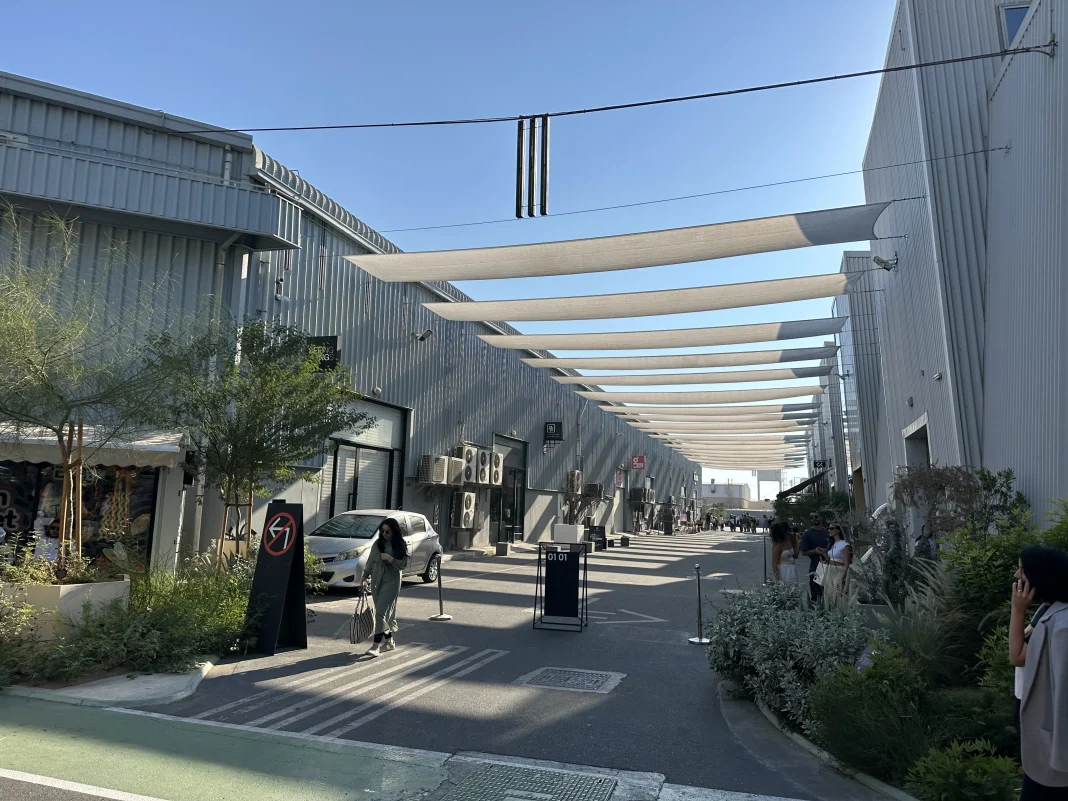
Dubai has a well-kept secret in the industrial district of Al Quoz that few tourists know about. Alserkal Avenue is that corner where contemporary art breathes without pretence, far from skyscrapers and crowds. A place that, since 2008, has turned 39 abandoned warehouses into the largest cultural district in the Middle East.
While Saadiyat Island in Abu Dhabi grabs headlines with its mega-museums, Alserkal follows a different philosophy. Here there are no endless queues or 20 euro tickets. Access is completely free and the atmosphere exudes unfiltered creativity.
From industrial area to regional art mecca
The transformation began when Ayyam Gallery set up there in 2008 as a pioneer. Back then, no one imagined that those dusty hangars would host the highest concentration of art galleries within a single square kilometer in the entire region. It was a risky bet.
Carbon 12 Dubai arrived in 2009 and marked a turning point. From there, the domino effect was unstoppable. Gallerists from across the Middle East saw in Al Quoz an opportunity to escape the astronomical rents of the city center.
The Concrete building: signature architecture by Rem Koolhaas
In March 2017, Alserkal Avenue took a qualitative leap with the opening of Concrete. It is the first completed project in the United Arab Emirates by OMA, the firm of Pritzker-winning architect Rem Koolhaas. A cube of concrete and glass with 600 square meters that alternates exhibitions, concerts and fashion shows.
The building features movable walls and a translucent façade that allow for multiple configurations. This spatial flexibility has turned Concrete into the preferred stage for events seeking a contemporary setting without artifices.
More than 70 creative spaces with no ticket or prior booking
Today, Alserkal Avenue brings together more than 60 galleries, design studios, private collections and community projects. All concentrated within a one-block radius, which makes it easy to explore the entire district in a single afternoon. No exhaustive planning is required.
The offer ranges from contemporary art from the Middle East, North Africa and South Asia to experimental spaces such as Cinema Akil (independent cinema) or A4 Space (black box theatre). In addition, the district includes specialty coffee shops, farmers’ markets on Saturdays and co-working studios.
The vision of Abdelmonem Bin Eisa Alserkal: growing without losing its essence
The mastermind behind this transformation is Abdelmonem Bin Eisa Alserkal, an Emirati businessman from a family of banking and automotive pioneers in Dubai. In 2012 he announced the doubling of the space, adding 62 more units to reach 92,000 square meters. The expansion was completed in 2015.
Alserkal has not wanted to turn the district into an art theme park. His goal is to preserve the industrial character and accessibility that set the place apart from other cultural projects in the region. That is why he refuses to charge admission or install access controls.
Essential checklist for your visit to Alserkal
Before you set out to explore the district, it is worth keeping these points in mind. Not everything works the same way as in a conventional museum, and knowing the unwritten rules enhances the experience.
✅ Free entry to all galleries (some temporary exhibitions may charge)
✅ Relaxed dress code: sneakers and jeans are welcome
✅ Photography allowed in most spaces (ask beforehand)
✅ Farmers’ market on Saturday mornings
✅ Best time to visit: October to April (cooler weather)
Do bear in mind, however, that during Ramadan some cafés close or change their opening hours. And if you visit in summer, be prepared for intense heat between galleries despite the air conditioning inside.
The cultural legacy Dubai was waiting for
Alserkal Avenue shows that Dubai can build cultural relevance without succumbing to gigantism or relying exclusively on mass tourism. The district has achieved the hardest thing: creating a community around contemporary art in a country with no prior museum tradition.
Today, when experts debate the authenticity of Emirati cultural projects, Alserkal offers a tangible answer. A space where local and regional artists exhibit without intermediaries, where conversations flow in Arabic, Urdu and English, and where art is experienced without pretence. If you have not discovered it yet, now you know where to find the Dubai that does not appear on postcards.