

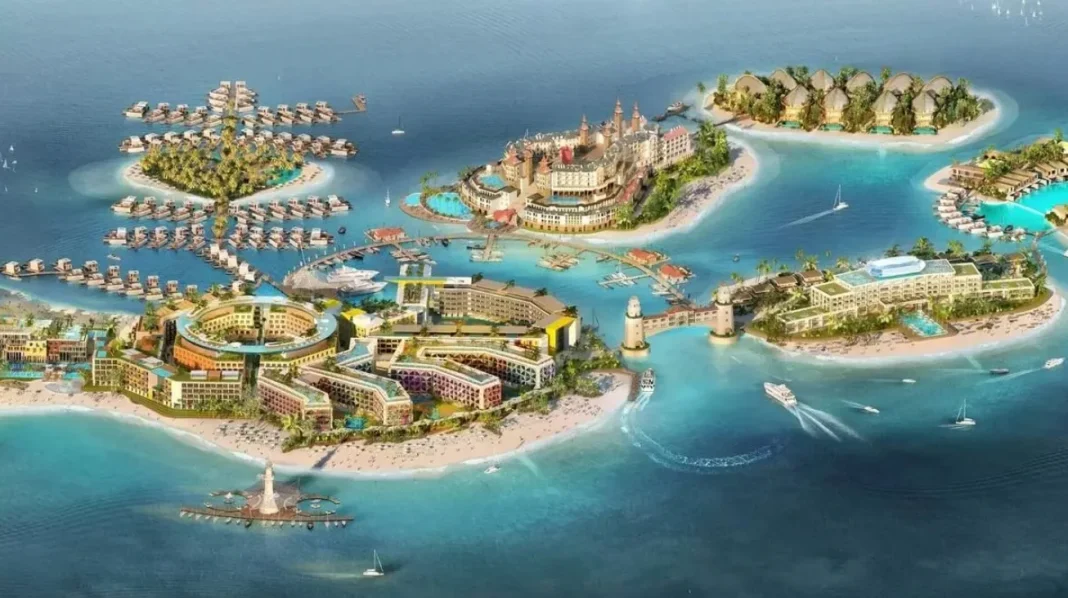
During nearly two decades, this artificial archipelago was the most visible symbol of the global financial crisis in the emirate, an incomplete map that seemed to slowly dissolve into the sea under the skeptical gaze of international investors. Today, however, the opening and consolidation of an ultra-luxury resort in the area corresponding to “South America” demonstrates that The World Islands has a second life, transforming that real estate failure into one of the most exclusive and sought-after destinations for those seeking absolute privacy just minutes from the metropolis.
Everything in Dubai seems designed to surpass the limits of human imagination, but building a world map on the waters of the Persian Gulf was undoubtedly the riskiest bet of all. What initially sounded like an engineering madness, a slap to conventional geography, quickly became the most talked-about project on the planet. However, rumors of its sinking and the halt of construction turned The World Islands into a floating ghost city, a place inhabited only by silence and sand stirred by ocean currents.
MORE THAN SAND IN OBLIVION
When the project was announced in the early 2000s, the idea of selling private islands shaped like continents seemed the culmination of the Emirati real estate boom. Dredgers worked day and night to move millions of tons of sand and rock that finally drew a world map on the Gulf waters, visible even from space. The World Islands promised to be the ultimate playground for the global elite, a place where you could breakfast in “France” and dine in “Australia” without a passport.
However, economic reality proved much harsher than the stone used for the breakwaters, leaving the archipelago deserted for over a decade. What was supposed to be a hive of mansions and five-star hotels was reduced to empty sand mounds, causing many to write off the project as dead and buried. Despite global skepticism, the basic infrastructure remained, patiently waiting for the market and the audacity of new investors to rescue The World Islands from oblivion.
AN OASIS IN THE SOUTH AMERICAN CONTINENT
The turning point came with the inauguration of the Anantara World Islands Resort, the first luxury hotel actually operating in the archipelago, located specifically in the geographical area of “South America“. This opening is not just a hotel milestone, but has managed to reactivate tourism in the area and demonstrate the commercial viability of the islands as a tangible reality. Guests no longer need to imagine what it would be like to live there; now they can experience it firsthand surrounded by impeccable service and architecture that respects the environment.
Situated on Clarence Island, this resort has capitalized on its geographical isolation to sell something impossible to get in the city: absolute silence and clear horizons. From its white sand beaches, the view offers a unique perspective of Dubai’s skyline, where the Burj Khalifa appears as a distant needle that does not disturb visitors’ peace. It is precisely this contrast that has turned The World Islands from a wasteland into the new object of desire for high-end tourism.
FIFTEEN MINUTES FROM CIVILIZATION
Getting here is a fundamental part of the experience, a small mental and physical transition that separates urban chaos from island tranquility. The speedboat ride from Jumeirah lasts just over a quarter of an hour, enough time for the traveler to fully disconnect from routine, leaving behind the noise of twelve-lane highways. As one enters the waters of The World Islands, the temperature seems to drop and the sea breeze takes center stage, rarely felt in the financial center.
Once the boat docks at the welcome pier, the feeling is like landing in a remote destination far from shopping centers and traffic, even though the coast remains visible. Staff receive guests with a leisurely pace that invites to immediately slow down, fostering a “barefoot luxury” atmosphere reminiscent more of a Pacific island than an Arab emirate. Here, time is measured by sunset cocktails rather than business meetings, a rarity in this region.
PRIVACY: DUBAI’S NEW GOLD
The private pool villas with direct sea access are designed to ensure guests can spend entire days without crossing paths with anyone if they wish. In a hyperconnected world, the possibility of disappearing off the radar for a few days has become the true modern luxury, and that’s where this resort has found its perfect market niche. Unlike hotels on Palm Jumeirah, where density is high, in The World Islands the sense of space and solitude is the most valuable asset.
This exclusivity has attracted celebrities, influencers, and royal families seeking to escape paparazzi and the usual city tourist bustle. The layout of the villas and the vegetation, which has grown surprisingly well, creates natural barriers against prying eyes, allowing a freedom hard to find in other coastal resorts. Curiously, the project’s initial “failure,” which kept the islands empty, now plays in its favor, ensuring no noisy neighbors or massive constructions in sight.
THE WORLD MAP COMES TO LIFE LITTLE BY LITTLE
The success of this hotel has served as a catalyst for other nearby projects, like the ambitious “Heart of Europe,” which is also accelerating its works to join the tourist offering. It seems that the The World Islands archipelago is finally starting to awaken from its long slumber, shaking off its reputation as a cursed project to claim its place on the world tourism map. What was once an example of financial hubris is now studied as a case of resilience and adaptation in the luxury sector.
Many islands remain to be developed and entire “countries” are still just sand, but public perception has changed radically thanks to the real experience offered by Anantara. No longer talk of sinking islands, but of the possibility of enjoying an almost virgin private paradise, a promise that The World Islands is fulfilling beyond expectations for those fortunate enough to afford it.