

Can a real estate project shift the balance of an entire market? Dubai Islands is doing exactly that in real time, and the numbers leave no room for doubt. The old dream of Deira, rebranded and relaunched with unprecedented ambition, has gone from being a promise on paper to one of the most coveted coastal assets on the planet.
In 2025, transactions in this artificial archipelago grew 156% in volume compared to the previous year, with a 51% increase in value according to data from Engel & Völkers Middle East. To put that in context: no other coastal area in Dubai recorded such explosive growth in operations during that same period.
Dubai Islands: Five Islands Rewriting the Coastal Map
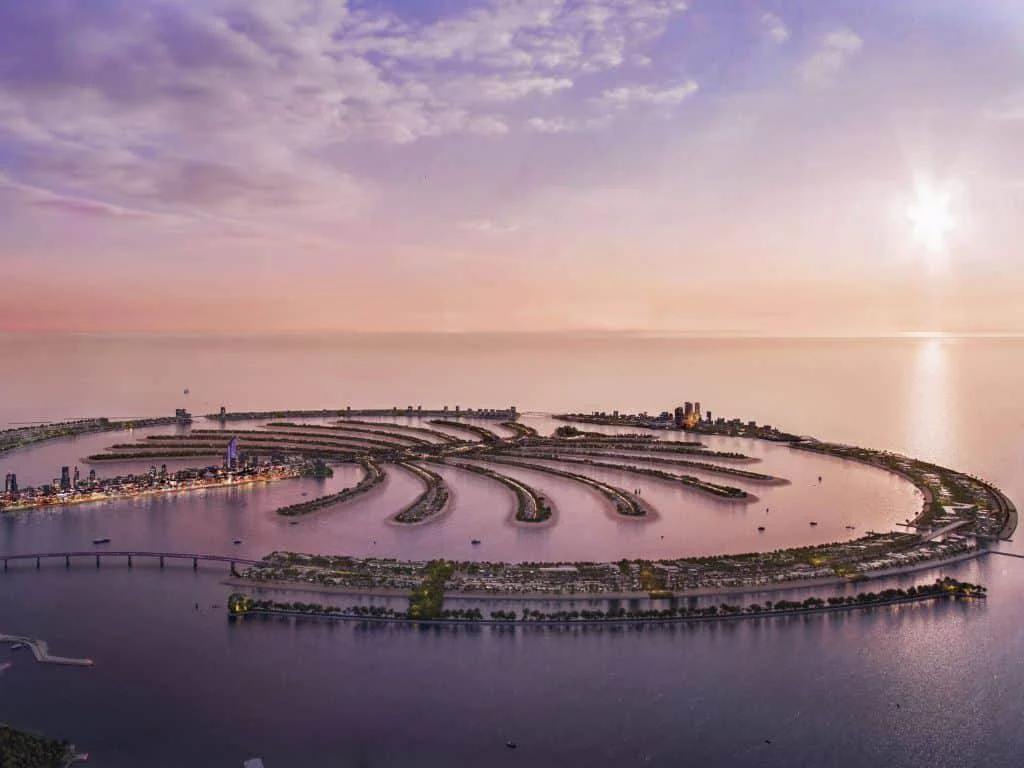
Dubai Islands is a 17-square-kilometer master development spread across five artificial islands off the coast of Deira. The project includes 87 projected hotels and resorts, 21 kilometers of beachfront, private marinas, golf courses, and luxury residences across different price ranges, starting from AED 1.8 million.
What sets Dubai Islands apart from other major coastal projects in Dubai is its deliberately low residential density. While other luxury areas have gradually become saturated, this archipelago bets on space, privacy, and direct connectivity to Dubai International Airport — an argument that few high-net-worth buyers ignore.
Dubai Islands’ Role in the Market’s Historic Record
Dubai’s real estate market closed January 2026 with AED 72.4 billion in residential transactions, 63% more than the same month the previous year. In that context, Dubai Islands positions itself as one of the main catalysts of that growth, with returns exceeding 8% per year in the premium apartment segment according to 2026 projections.
The architect behind this project is Nakheel, the same developer that transformed Dubai with Palm Jumeirah. Its track record is a sales argument in itself: when Nakheel builds an island, prices of nearby assets appreciate steadily for years. Bay Grove, Bay Villas, and Rixos Residences are just the first launches of a pipeline that will extend over the next decade.
Emaar and Nakheel: Two Giants Driving Dubai Islands from Different Flanks
Emaar Properties closed 2025 with sales of AED 80.4 billion, a 16% increase from 2024, and record total revenues of AED 49.6 billion. Although Emaar is not the master developer of Dubai Islands, its widespread market activity acts as a confidence barometer: when Emaar breaks records, the entire sector accumulates momentum and liquidity.
Nakheel, for its part, has concentrated its main 2025 and 2026 launches precisely in Dubai Islands, turning the archipelago into its most ambitious strategic bet. Private developers such as Ellington Properties, Samana Developers, and Mr. Eight Development have joined the table — an unequivocal sign that the secondary market of Dubai Islands already has muscle of its own.
What’s Behind the Boom: Investors, Tourism, and the Airport Card
The appreciation of Dubai Islands is not driven by speculative momentum but by a combination of structural factors. The proximity to Dubai International Airport — the busiest in the world — turns properties into highly liquid assets for vacation rental and residency for executives in frequent transit.
Premium tourism is the other engine. With 87 projected resorts, short-term rental demand in Dubai Islands has guaranteed absorption for years. This, combined with the UAE’s tax policy — no income tax or capital gains tax — creates a scenario that attracts institutional capital and family wealth from Asia, Europe, and Latin America with a coherence that few markets can replicate.
| Indicator | 2024 | 2025/2026 |
|---|---|---|
| Transactions in Dubai Islands | Base | +156% in volume |
| Coastal sales value in Dubai | AED 69,311M | AED 97,233M (+40.3%) |
| Total Emaar sales | AED 69,300M | AED 80,400M (+16%) |
| Estimated ROI premium apartments | ~6–7% per year | +8% per year |
| Dubai residential transactions (January) | ~AED 44,600M | AED 72,400M (+63%) |
Dubai Islands in 2026 and Beyond: The Window Is Still Open
Analyst consensus points to Dubai Islands still being in an early stage of its maturity cycle. Island E, designated for ultra-luxury villas, has not yet come to market with its full offering, meaning an investor who enters today does so before the brand narrative is fully consolidated — and therefore before prices reflect the premium that Palm Jumeirah took years to accumulate.
The advice repeatedly given by the most cautious analysts is the same: do not wait for Nakheel to complete the visible infrastructure before taking a position. In projects of this scale, by the time the beaches and resorts are photogenic and complete, entry prices have already risen between 30% and 50% from launch. In Dubai Islands, that moment of visible maturity has not yet arrived.