


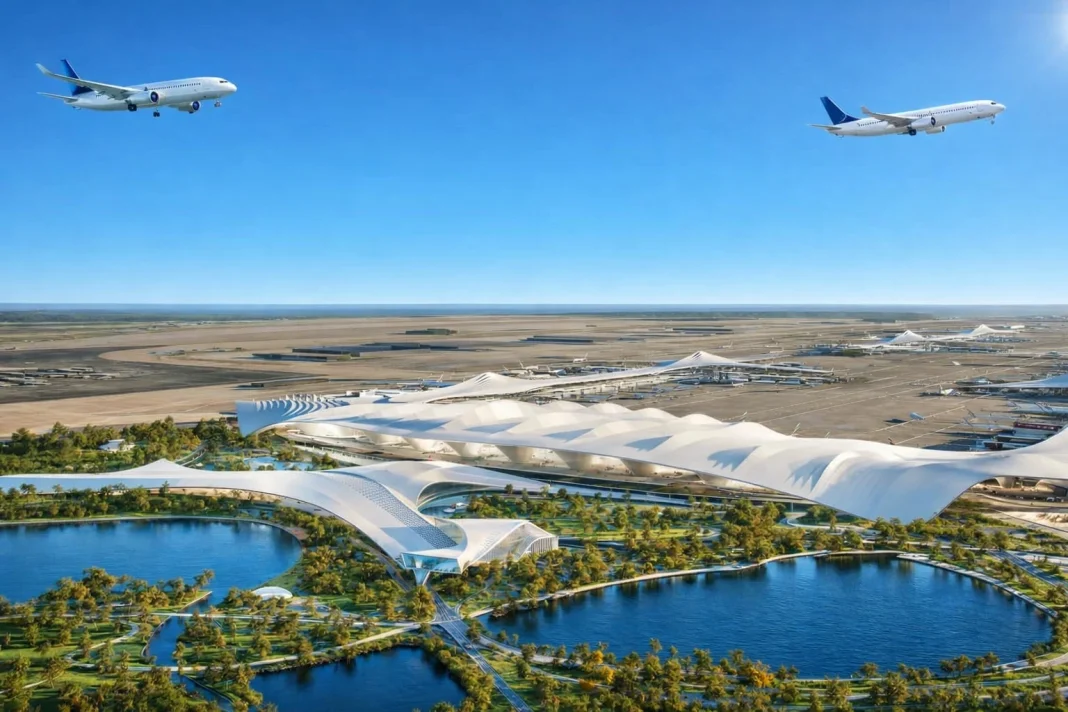
Do you really think the world’s busiest airport is enough for Dubai? The emirate has just proven it is not: while the historic DXB continues to break records with 90 million annual passengers, the government is already executing at full speed the construction of a successor five times larger.
The Al Maktoum project —backed by an investment of 128 billion dirhams (about 35 billion dollars)— does not simply seek to expand capacity. It aspires to redesign global economic geography from a desert 40 kilometers from downtown Dubai.
Dubai abandons its crown jewel to build something bigger
Dubai International Airport (DXB) is today the busiest on the planet in international traffic. However, the emirate’s government plans to transfer all its operations to the new Al Maktoum as soon as the infrastructure reaches its operational capacity, approximately starting in 2032.
The reason is as simple as it is devastating: DXB will run out of room for physical expansion around 2031. Dubai does not allow bottlenecks, and the solution is not a patch but a complete rewriting of the global air hub concept.
The phases that turn Dubai into the center of the world
The Al Maktoum development plan is structured in three strategic stages. The first —currently under execution— will deliver the new West Terminal, Concourse 1 with 100 boarding gates, four runways, and capacity for 150 million passengers per year by 2032. To put that figure in context: it already exceeds the maximum capacity of any existing airport on the planet.
Dubai continues with Phase 2 adding Concourse 2 and doubling operational capacity, while Phase 3 —planned for 2050— will complete Concourses 3 and 4, the East Terminal, and direct connections with the Al Maktoum Dubai Metro Blue Line and the Etihad Rail network. The final result: 260 million passengers and 12 million tons of cargo per year.
An airport designed to move the whole world
What distinguishes Al Maktoum from any other airport infrastructure under construction is not just its size. It is its conception as a multimodal ecosystem: the terminal will be integrated with the port of Jebel Ali —the largest in the Middle East— and with logistical corridors that directly connect Asia, Europe, and Africa without transshipment.
Dubai has designed a complete city around the airport: Dubai South, a 145-square-kilometer district with residential, industrial, free trade zones, and data centers. It is not about building an airport with neighborhoods around it, but a city with an airport at its core.
The impact on Dubai’s economy and tourism
Each phase of Al Maktoum acts as a value detonator in the local economy. Land in Dubai South is already recording a 40% higher demand in 2026, and analysts estimate that the arrival of the first international flights in 2027 will generate immediate demand for accommodation for crews, airport staff, and logistics workers.
For tourism, the implications are equally profound. Dubai today receives about 17 million annual visitors, but with an airport capacity three times higher and integrated rail connections, government projections aim to make the emirate the most visited destination on the planet before 2040, surpassing Paris and Bangkok.
| Indicator | DXB (Current) | Al Maktoum (Phase 1, 2032) | Al Maktoum (Complete, 2050) |
|---|---|---|---|
| Passenger capacity/year | 90 million | 150 million | 260 million |
| Tons of cargo/year | 2.5 million | 6 million | 12 million |
| Number of runways | 2 | 4 | 5 |
| Boarding gates | 180+ | 100 (Concourse 1) | 400 |
| Rail connection | No | Partial | Blue Metro + Etihad Rail |
Dubai as a hub of the future: what comes after the airport
The perspectives for the next decade are of a magnitude difficult to imagine from Europe. When Al Maktoum reaches its first full operational phase in the early 2030s, Dubai will have consolidated an unprecedented geoeconomic position: the only node on the planet capable of simultaneously managing mass tourism, top-tier air cargo, and intercontinental connectivity from a single integrated complex.
For investors, companies, and frequent travelers, the advice of specialized analysts is unanimous: do not wait for the work to be finished to make decisions. The most powerful valuation cycles in infrastructure of this scale always occur during construction, not after. Dubai has proven it before with the Burj Khalifa, with the Palm Jumeirah, and now it repeats it with Al Maktoum.