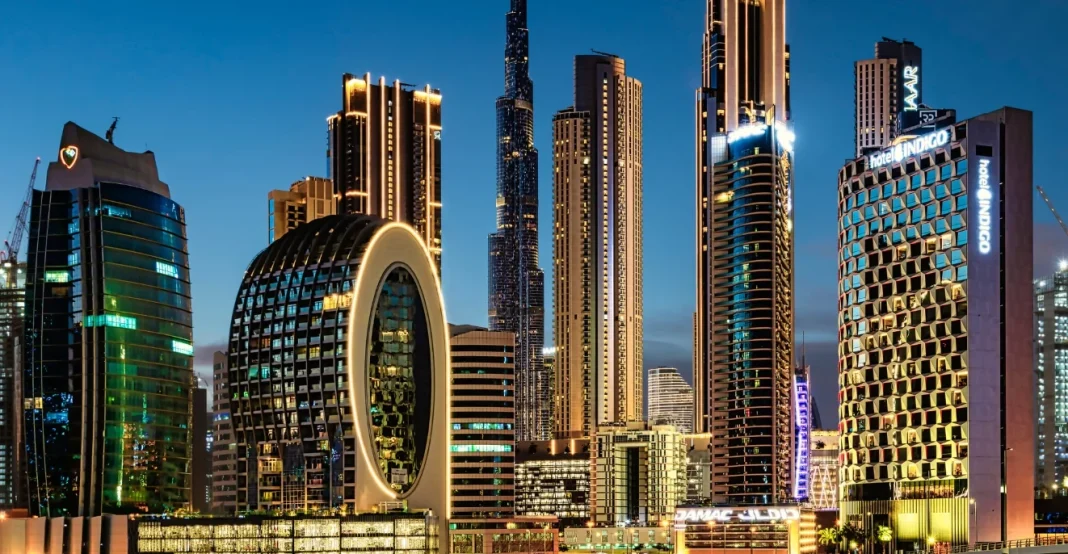


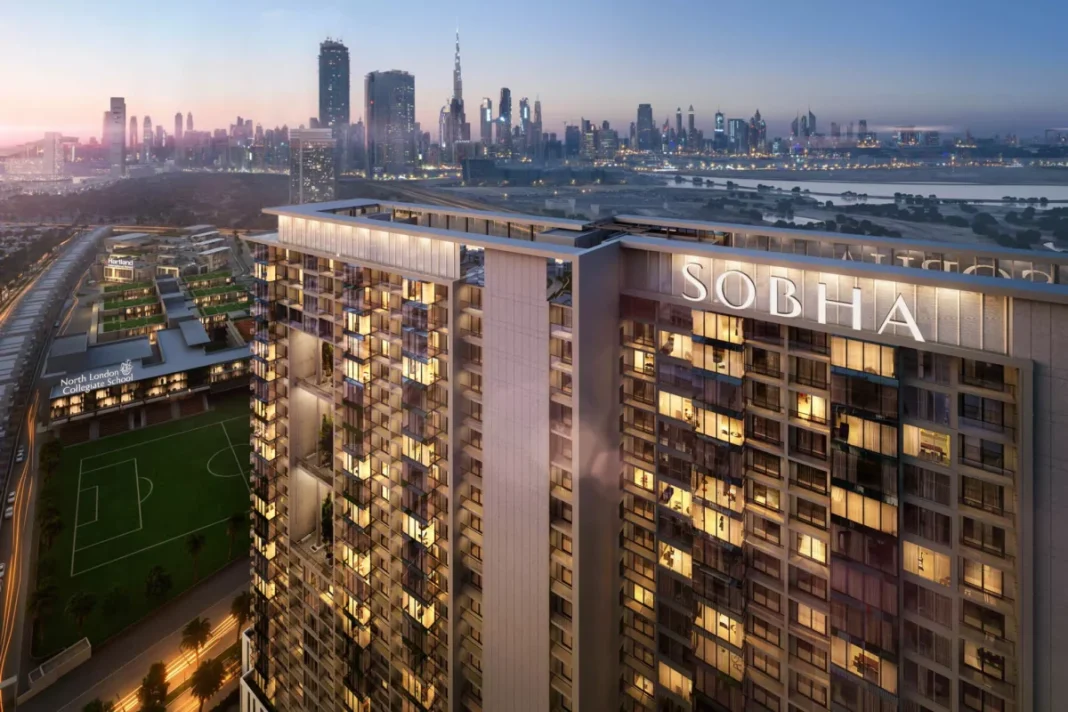
How much return were you expecting from Dubai Hills Estate before reading this? Probably less than what you’re about to find. The residential community that many classified as “expensive but stable” has broken in 2025 every ceiling that had been placed on it, with gross yields above 7% on three-bedroom apartments and a cumulative appreciation over 24 months that approaches 46%.
That figure is not a projection: it is a recorded number. And what makes it relevant is not just the number itself, but that it occurs in a context where other global luxury markets are slowing down. While London, Singapore, or Paris see their residential yields falling, Dubai Hills Estate keeps accelerating. The question is no longer whether it is worthwhile, but whether there is still room to grow.
Why Dubai Hills Estate Is Breaking Profitability Models
Dubai Hills Estate is not just another development on Dubai’s skyline. It is a planned city within the city, developed by Emaar Properties, bringing together more than 26,000 residential units, a professional 18-hole golf course, 180,000 square meters of central park, and Dubai Hills Mall with 650 establishments. That density of services is precisely what makes the asset difficult to replicate.
The formula appears simple but is complex in execution: controlled supply scarcity, structural demand from international families, and a location between Al Khail Road and Umm Suqeim Road, with direct access to Downtown Dubai and Dubai Marina. When all three factors align, the market does not speculate: it consolidates value.
Dubai Hills Estate and the Real ROI Data for 2025 and 2026
The figures circulating about Dubai Hills Estate are not marketing: three-bedroom apartments have reached a gross ROI of 7.05%, while two-bedroom units stand at 6.18% and studios at 5.41%. Villas, with slightly tighter yields between 4.49% and 5.14%, compensate through capital appreciation: proximity to the golf course adds a 20% premium on the valuation price.
The data platform Dubai Hills Estate and the Emaar freehold market point in the same direction: off-plan projects in the community have risen 53% year-on-year in launch price, and buyers who entered in 2022 and 2023 are seeing appreciations in some cases exceeding 100%. It is not the market it was three years ago.
What Is Driving Demand in This Market Cycle
The buyer profile in Dubai Hills Estate has changed. It is no longer just the high-net-worth investor seeking tax shelter. The dominant profile in 2025 and 2026 is the international family —European, Latin American, Indian— looking for a primary residence with access to top-tier schools, healthcare infrastructure, and green spaces in a low-crime environment. That demand does not disappear at the first price adjustment.
Added to that is a structural factor that many analysts underestimate: the future metro station integrated into the community. When it comes into operation, pricing models project an additional appreciation of between 20% and 25% from the infrastructure effect alone. The market is already pricing part of that potential into current values.
Profitability Table by Property Type in Dubai Hills Estate
| Property Type | Estimated Gross ROI | Main Demand | Differential Advantage |
|---|---|---|---|
| Studio | 5.41% | Young professionals | High tenant turnover, quick liquidity |
| 1-bedroom apartment | 5.68% | Couples and expats | Balance between yield and maintenance |
| 2-bedroom apartment | 6.18% | Small families | Competitive price-to-surface ratio |
| 3-bedroom apartment | 7.05% | Mid-size families | Highest gross ROI in the community |
| 3-bedroom villa | 4.49% | Families with children | High long-term capital appreciation |
| 4-bedroom villa | 5.06% | Premium residents | Golf proximity premium (+20%) |
Dubai Hills Estate in 2026: Forecast and Expert Advice
Projections for 2026 as a whole point to a price growth of between 15% and 20%, with an additional boost of 6% to 8% in the central quarters of the year from the delivery of new phases of Dubai Hills Estate. The rental market will sustain that upward pressure: demand for family housing in masterplanned communities far exceeds available supply.
The advice consistently repeated by analysts with real market exposure is always the same: enter before the metro station becomes a reality. Once inaugurated, the price differential between inside and outside the community will widen irreversibly. For the Spanish investor evaluating Dubai Hills Estate today, the window is not infinite.