

Barcelona was supposed to be Spain’s real estate bargain. High price, high demand, guaranteed appreciation. The problem is that, as of the end of 2025, the Catalan capital offers only a 5.6% gross rental yield. That’s just the way it is.
The real estate market in Dubai has been rewriting those rules for years, and 2026 has put Business Bay in the spotlight as the hottest area of the year. It’s not hype: this is where the city’s most ambitious luxury projects are concentrated, and where returns easily double what any Spanish capital can offer.
What is Business Bay and why it matters now
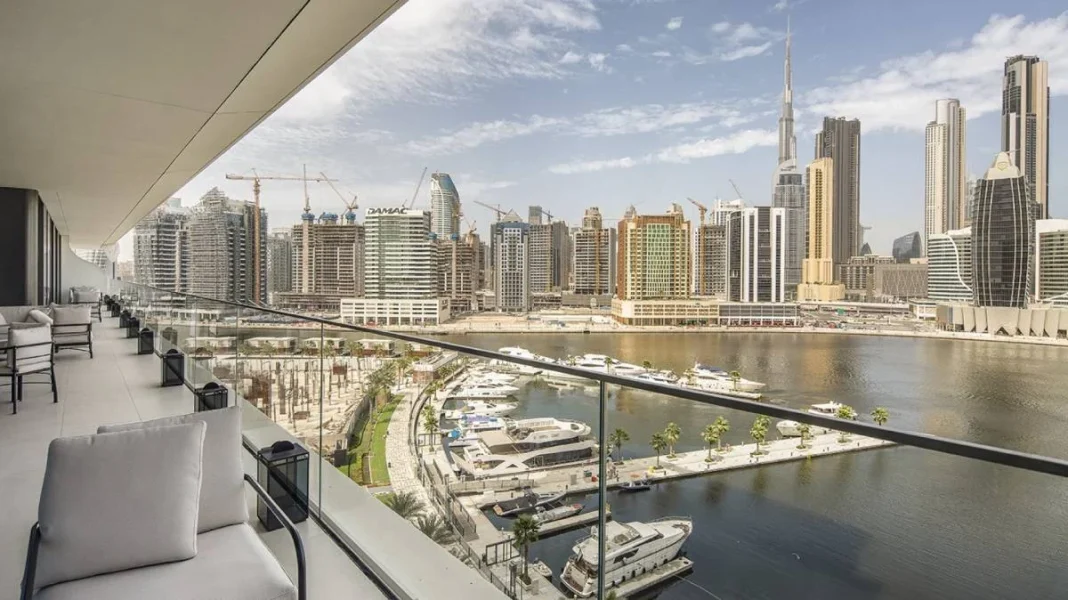
Business Bay is the financial and residential district surrounding Dubai Canal, right next to the Burj Khalifa and the heart of Downtown. It’s not a new neighborhood: it has been consolidating for over a decade, but in recent years it has made the definitive leap to a full-scale luxury destination.
What’s happening here is large-scale: Business Bay concentrates more than 23,700 residential units under development through 2030, according to Dubai’s official housing pipeline published this February. The most striking project right now is the Regent Residences Dubai, Sankari Place, two 180-meter towers designed by Foster + Partners connected by a suspended swimming pool, valued at $1 billion, with delivery scheduled for late 2027.
The finishes speak for themselves: spa, padel courts, wine cellar, cinema, golf simulator, and direct access to the Marasi Marina waterfront. There is no equivalent in Barcelona at this relative price per square meter with these tax conditions.
Why now: data driving the market in 2026
In contrast to European fiscal stagnation, Dubai has accelerated its appeal to investors this very year. The numbers that explain the moment:
- February 2026: noticias.ae confirms that Spanish investors are already accessing 10-year residency with mortgaged properties in Business Bay
- Barcelona, Q4 2025: residential rental yield at 5.6% (Idealista, January 2026)
- Dubai, long term: average yield of 6–8% per year; vacation rental, between 8% and 14%
- Tax difference: Dubai has no income tax or capital gains tax for individual investors
- Business Bay pipeline: 23,752 new units under development through 2030, in that area alone
| Market | Gross yield | Income tax on rental income | Tax residency possible |
|---|---|---|---|
| Barcelona | 5.6% | Up to 47% (Spain) | Not through investment |
| Business Bay (Dubai) | 8–14% | 0% | Yes, 10-year Golden Visa |
How it affects the Spanish investor’s pocket
The problem gets worse when you calculate the actual net return. An apartment in Barcelona at €400,000 yielding 5.6% gross generates around €22,400 per year. After income tax at the corresponding bracket — between 19% and 47% — the actual net return falls below 4% in most cases.
In contrast, a similar property in Business Bay with a vacation rental yield of 10% per year on €400,000 generates €40,000 gross. With no tax withheld at source. The Dubai Land Department applies no income tax or tax on rental earnings for non-residents. The net difference between both options can exceed €20,000 per year per property — a figure that many wealth managers in Spain are already sharing with their most active clients.
What the Golden Visa means: the asset you don’t see on the spreadsheet
Beyond pure returns, real estate investment in Dubai activates a mechanism with no equivalent in Europe: the Golden Visa. With an investment of 2 million AED (just over €500,000, although many investors go in at €750,000 or more to have a margin), the investor gains access to a 10-year renewable residency, extendable to spouse and children.
This accelerated in 2025, when the UAE expanded eligible categories and included off-plan properties as a valid asset for the application, with at least 50% paid or a bank guarantee. The process, once the investment is completed, takes between 4 and 8 weeks from application to visa issuance. It does not require actual residency: the investor keeps their home in Spain and uses Dubai as a tax-free wealth accumulation platform.
Clearing up doubts we all have
The same questions keep coming up among Spanish investors entering this market for the first time:
Q: Do I have to live in Dubai to keep the Golden Visa?
A: No. It does not require a minimum effective residency; you just need to keep the investment active.
Q: Can I finance the purchase with a mortgage and still qualify for the visa?
A: Yes, as long as you have paid at least 50% of the value or provide a bank guarantee.
Q: Is the 10–14% return guaranteed?
A: Not as a general contractual guarantee; that range corresponds to well-managed vacation rentals in prime areas like Business Bay. Some developers offer a guaranteed 7% net yield for 3 years on specific projects.
Q: How is Dubai-generated income taxed in Spain?
A: Spain taxes the worldwide income of its tax residents; consult a tax advisor before structuring the investment.
What will happen in Business Bay over the coming months
Looking ahead, Business Bay is not going to slow down. The Dubai 2040 Urban Master Plan allocates 300 billion dirhams to infrastructure by that date, and Business Bay is listed as one of the priority expansion hubs. Projects currently under construction — such as the 532-meter Tiger Sky Tower, valued at €866 million and scheduled for 2029 — will redefine the skyline and, with it, the value of surrounding assets.
For the Spanish investor, the most interesting window remains off-plan: lower entry price, flexible payment plans, and the possibility of applying for the Golden Visa from the first installment paid. That combination — an appreciating asset, competitive vacation rental income, and an alternative tax residency — explains why the profile of European buyers in Dubai has grown steadily throughout 2025.
The money that once went into an apartment in the Eixample is increasingly looking toward the Business Bay canal. And the numbers, this time, need no translation.