

Palm Jumeirah is not a vacation destination. It is a profitability machine in the shape of a palm tree that has spent years humiliating European paradises on the only metric that matters to investors: net annual return. And while Spaniards keep fighting over an apartment in Ibiza that only rents for four months, this keeps growing.
Dubai’s market closed 2025 with 19.59 million international visitors, a historic record that translated directly into maximum occupancy in premium areas. Since January 2026, data from the real estate barometer confirm that short-term vacation rentals on the artificial islands maintain net yields of 8-11% per year. The argument for investing in Dubai has become hard to ignore.
What Is Palm Jumeirah and Why It Dominates
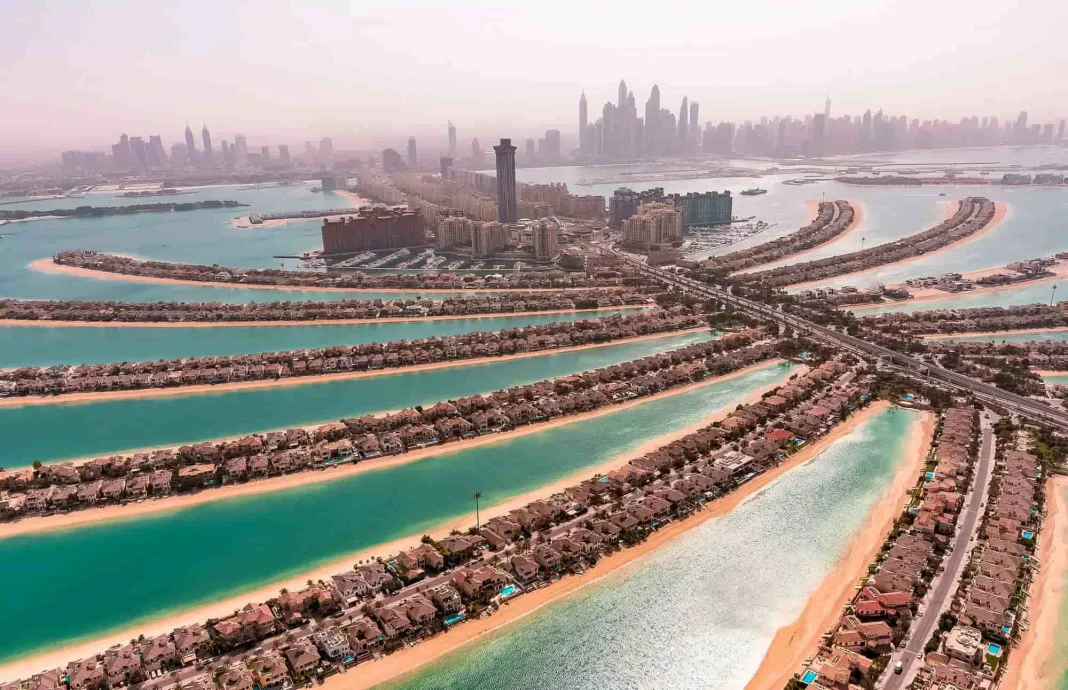
If you still don’t know what this is about, here’s the quick summary. Palm Jumeirah is an artificial island built off the coast of Dubai in the shape of a palm tree, visible from space and designed for one thing only: to concentrate the most expensive luxury on the planet within a few square kilometers.
In that video you can see exactly how the island is structured, what types of properties are available, and why prices have multiplied between 5 and 10 times since its creation. The villas on the palm’s “fronds” have direct access to the Persian Gulf, with a private beach, 24-hour perimeter security, and professionally managed communities. There is nothing comparable in the Mediterranean at an equivalent price.
Why This Is Exploding in 2026
The trigger is very specific. Dubai launched in February 2026 a new round of Golden Visas that lowers the real estate investment threshold, which has skyrocketed international demand for properties in premium areas.
The hard data from the latest barometer are:
- Net rental yield in premium areas of Dubai stabilized at 8-11% per year in January 2026
- Palm Jumeirah recorded more than 32,000 real estate transactions across the emirate in 2025, a historic record
- The average price per m² in frond villas exceeds $12,000, compared to €18,000-22,000/m² on Ibiza’s frontline
- Short-term vacation occupancy did not fall below 87% monthly in any month of 2025
- Zero income tax, zero capital gains tax
How This Affects the Spanish Investor
Faced with this scenario, the contrast with the Spanish market is painful. A frontline apartment in Ibiza at €900,000 generates, at best, €45,000 gross annually over four months of high season. The rest of the year: community fees, property tax, and the anxiety of the dead winter.
In Palm Jumeirah, that same investment generates income all 12 months of the year. Dubai has no tourist winter: between October and April, when the heat drops to 20-25 degrees, the city becomes the favorite destination for wealthy Europeans, Asians, and Latin Americans. The consequences for the investor are 30-40% more annual income than in any Mediterranean destination of similar price, with a tax burden that is unthinkable in Spain.
What This Model Implies in the Long Term
Beyond annual profitability, the mechanism that makes Palm Jumeirah different is the combination of physical scarcity and growing demand. You cannot build more island. The private beach villas are a fixed number that will never increase, while the tourists arriving in Dubai grow every year.
This reveals something important about the direction of the market in 2026: high-net-worth Spanish investors have begun to abandon the Mediterranean model of short seasons and are looking at markets with no seasonality. Dubai, Abu Dhabi, and Ras Al Khaimah are capturing that demand. The return on investment in Palm Jumeirah, with 10% net yields, occurs in 9-10 years, compared to 20-25 years under the current Ibiza model including Spanish tax pressure.
Clearing Up Doubts We All Have
The same questions always come up when talking about investing outside Spain, especially in markets perceived as distant or exotic.
Q: Is it legally safe to buy in Dubai?
A: Yes, the UAE has had freehold property registration for foreigners in designated areas since 2002, with full title deed.
Q: What if I want to sell?
A: No capital gains tax or withholding at source; just a 4% transfer fee paid by the buyer.
Q: Can I manage the rental from Spain?
A: Yes, there are specialized local management companies that operate short-term rentals with commissions of 15-20% on income.
Q: What return is realistic to expect?
A: Between 7% and 11% net per year on short-term vacation rentals, depending on location and type of property.
What Will Happen in the Coming Months
Looking ahead, the calendar works in favor of the investor who moves now. Dubai has announced an investment of $22 billion in tourism and residential infrastructure through 2030, which has historically preceded price increases of 20-30% in adjacent areas.
The next steps for the market are clear: more short-term rental demand as luxury tourism continues to grow, more scarcity of prime product on Palm Jumeirah’s frontline, and more Spanish and Italian investors looking to exit the Mediterranean model. Those who bought on the palm five years ago have seen their investment double. Those who buy today have a documented appreciation horizon, without seasonality and with the rules of the game written on paper. Ibiza will continue to be beautiful. But the numbers no longer add up the same way.