

The Dubai International Financial Centre has stopped being just another financial district to become the most coveted asset by international funds. While residential apartments accumulate inventory and prices skyrocket without restraint, Grade A corporate offices register 95.5% occupancy and waiting lists that extend for months. The equation has changed: zero tenant risk, long contracts, advance payments.
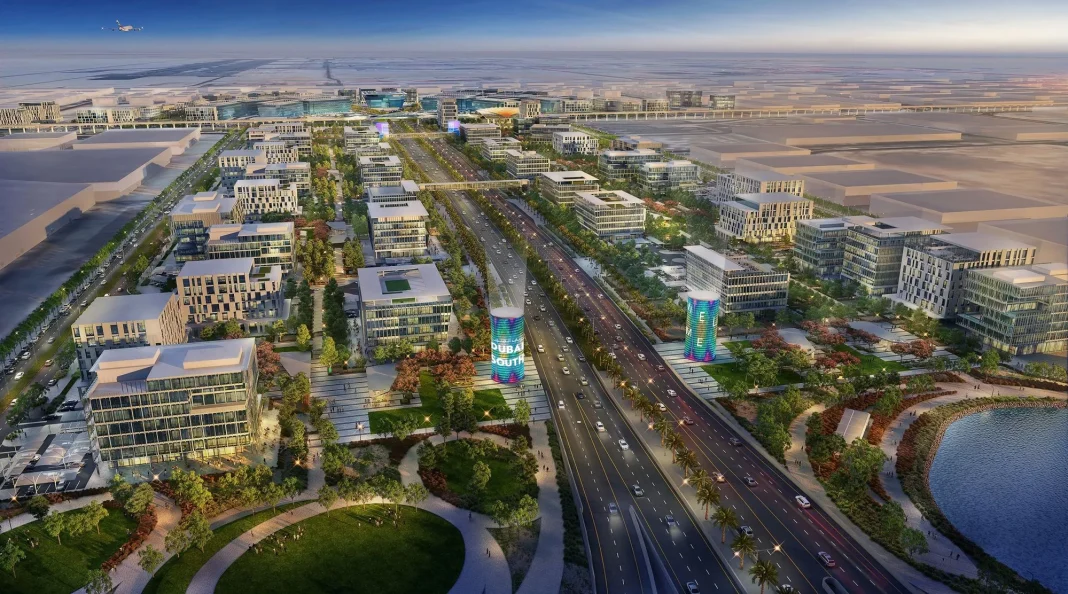
This is exploding now due to the US$27 billion expansion announced in January 2026 for the DIFC Zabeel District, which confirms the saturation of the current center with 7,700 installed companies versus capacity for barely 5,000. Occupancy has hit the ceiling and major wealth managers (Millennium Management, State Street) are pressing for space in a DIFC that hasn’t been able to keep up since the pandemic turned Dubai into a global tax haven.
The Asset Wall Street Already Bought
Grade A corporate offices in DIFC generate gross returns of 10-12% annually, almost double that of premium residential (6-7%). The secret lies in the contracts: financial firms sign for a minimum of 5 years, pay quarters in advance, and assume maintenance costs. Your risk as an investor is reduced to zero. Forget about defaulting tenants, quarterly turnover, or periods without rent.
The typical format: square meters in corporate towers within the financial district, managed by specialized operators who take care of everything. Millennium Management occupies entire floors with automatically renewable contracts. State Street Corp expanded its presence in 2025 after detecting the structural shortage. These are not volatile tenants; they are institutional anchors.
The barrier to entry remains high: minimum investment from US$800,000 to access fractional corporate spaces. But the returns compensate for the initial ticket, especially when compared to US Treasury bonds (4.5%) or bank deposits (3%). The 7 percentage point differential attracts European and Asian institutional capital.
Why It’s Exploding Now
The change began in January 2026 with the announcement of the Zabeel expansion, but the tension had been building since 2023. Dubai managed to attract more than 100 hedge funds and nearly 500 wealth managers after the pandemic, leveraging its tax regime (0% corporate tax in free zones) and time zone bridging Asia and Europe. The problem: they built offices for 5,000 companies, 7,700 arrived.
Tangible signs of the corporate boom:
- Record occupancy: Grade A offices reached 95.5% in Q3 2025, compared to 78% in 2020 (Cushman & Wakefield)
- Urgent expansion: US$27 billion allocated to expand DIFC by 17.7 million square feet by 2040
- Business growth: From 5,523 companies in 2024 to 7,700+ in 2025, a 39% increase in 12 months
- Employment overflow: 48,000 current workers exceed capacity designed for 35,000 people
| Metric | 2020 | 2025 | Change |
|---|---|---|---|
| Installed companies | 3,200 | 7,700 | +140% |
| Grade A occupancy | 78% | 95.5% | +17.5pp |
| District employees | 28,000 | 48,000 | +71% |
| Hedge funds | 34 | 100+ | +194% |
| Wealth managers | 187 | 500+ | +167% |
The table reveals the critical point: they built infrastructure for a pre-pandemic scenario, but the tsunami of global capital overwhelmed them. That’s why the first phase of Zabeel (US$5.4 billion) starts in 2026, not in 2030 as initially planned.
How It Affects the Traditional Investor
Faced with this scenario, the investor who bet on residential apartments in Dubai Marina or Downtown faces tenant turnover every 12-18 months, dead periods of 2-3 months between contracts, and net returns of 5-6% after deducting management and maintenance. Corporate offers the opposite: anchor tenant for 60 months, zero vacancy between renewals, and net return of 9-10%.
The blow comes from the initial capital. While a residential studio in Business Bay starts at US$180,000, a fractional corporate space in DIFC starts at US$800,000. Institutional firms took up 73% of available supply between 2023-2025, leaving out individual investors without an investment vehicle structure.
The consequences are already being felt: Spanish and Latin American funds that entered residential in 2022-2023 are now rethinking their strategy. Residential continues to work, but corporate offers superior mathematics for large tickets. Millennium Management renewed its contract at Gate Avenue Tower for 7 years with a 3% annual increase clause, securing inflation-adjusted returns.
What It Means for the 2026-2030 Market
Beyond specific figures, this reveals a structural change in the distribution of Dubai’s real estate capital. The residential market absorbed US$82 billion between 2020-2024, but the cycle shows signs of maturity: inventory at highs, prices per m² disconnected from rents, developers launching speculative projects. Corporate, on the other hand, has verifiable real demand (7,700 companies) and insufficient supply (95.5% occupancy).
The mechanism behind it is simple: Dubai now competes with Singapore, Hong Kong, and Luxembourg as a financial hub, not with Marbella or Miami as a residential destination. The US$1.8 trillion in sovereign wealth from Abu Dhabi and the US$1 trillion from Saudi Arabia’s Public Investment Fund (PIF) need corporate infrastructure for fund managers, not more residential towers. Gulf governments prioritize offices over housing.
This explains why the Zabeel expansion allocates 44% of land to offices and only 35% to residential (4,000 apartments), inverting the traditional 60% residential / 40% commercial proportion of previous developments. The master plan through 2040 projects capacity for 42,000 companies, almost 6 times the current number. The bet is not tourist, it’s institutional.
Dispelling Doubts We All Have
Doubts are logical when the numbers sound too perfect. Here are the direct answers:
Q: Why 12% return if residential yields 6-7%?
A: 5-year corporate contracts with advance payments eliminate vacancy risk and default, 4-5% premium over residential.
Q: What happens if the tenant company goes bankrupt?
A: Contracts include 6-12 month deposits and automatic substitution clauses managed by the building operator.
Q: Can I buy an individual office or only through funds?
A: Both options exist: direct purchase from US$800K or REIT fund participations from US$50K with distributed returns.
Q: Won’t the Zabeel announcement saturate the market and lower rents?
A: First phase delivers in 2030, demand projects 42,000 companies by 2040 vs 7,700 current, gradual absorption guaranteed.
What Will Happen in the 2026-2030 Window
Looking ahead, the 2026-2030 period marks the last window to enter DIFC corporate before Zabeel saturation. The first buildings of the expansion will deliver in 2030, adding supply pressure that will moderate returns to 8-9%. But these four intermediate years maintain the imbalance: occupancy over 93%, active waiting list, owner’s bargaining power.
The next steps for institutional investors involve structuring collective investment vehicles that fractionate complete corporate spaces. European family offices have already created SPVs (Special Purpose Vehicles) in DIFC to buy entire floors at Gate Avenue, fractionate them among 8-12 investors, and distribute quarterly rents. The model reduces the ticket to US$400K-600K while maintaining corporate exposure.
Meanwhile, residential will continue to work for retail investors and short-term speculators, but the new elite of Dubai real estate capital is concentrated where contracts are long, tenants are Goldman Sachs and Blackstone, and returns exceed double digits. The question is not whether corporate works, but how much time remains before the big funds take up all available supply.