

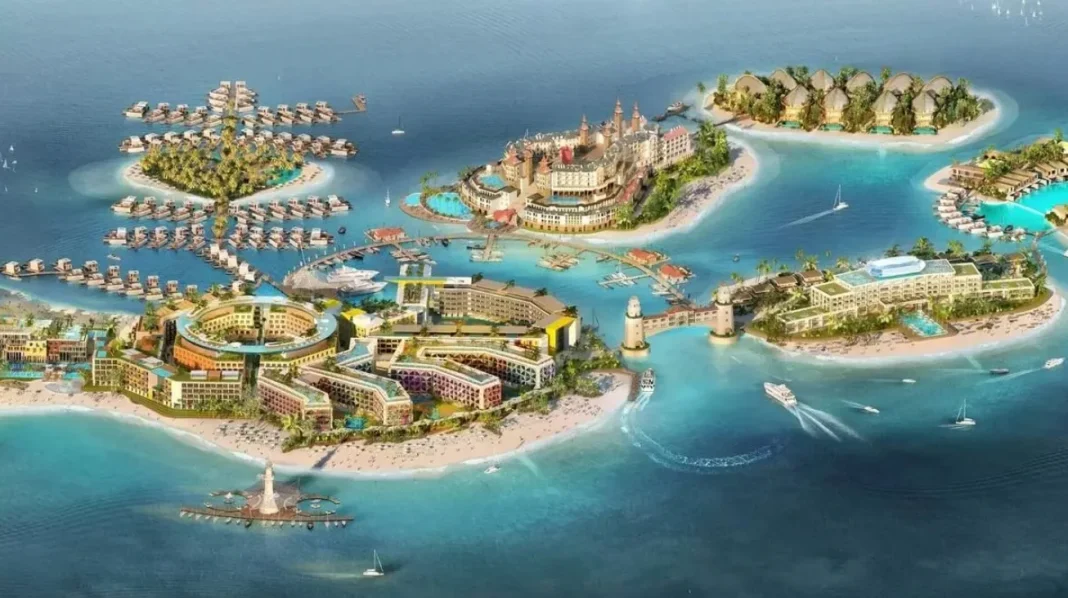
The World Islands, the artificial archipelago that promised to replicate the world map four kilometers off Dubai, was for years the symbol of the most spectacular real estate failure in the Persian Gulf. Ghost islands, sinking rumors, fleeing investors. Until now.
Since December 2025, the massive delivery of keys for the Floating Seahorse has reactivated confidence in The World Islands. These three-level floating villas—with a master bedroom submerged underwater—are already renting for $13,000 per night, positioning themselves as direct competition to the Maldives, just fifteen minutes by boat from Downtown Dubai. Aggressive yield investors calculate annual returns of 8-10%.
From global fiasco to exclusive destination
The video shows the magnitude of the project: 300 artificial islands created with 321 million cubic meters of sand. It cost $14 billion and the 2008 crisis left it abandoned, with 60% of the islands sold but empty. For more than a decade, The World Islands was a sand cemetery visible from satellites.
Today, Anantara World Islands resort operates at full capacity with occupancy close to 85% during high season. The Floating Seahorse—42 floating villas from the Heart of Europe project—are finally being delivered after years of delays, and 36 units already have owners. The perception change is brutal: from cursed project to trophy asset.
Why the market believes again
The reactivation is no coincidence. Several concrete factors explain the turnaround:
- Actual delivery of units since Q4 2025: Floating Seahorse completes delivery phase after almost 6 years of delay, generating tangible proof for skeptical investors
- 85% hotel occupancy at Anantara: Verified data from December 2025, demonstrates real demand from premium tourism willing to pay for absolute privacy
- Rentals at $13,000 USD/night: Floating Seahorse positions itself in the Maldives range but with Dubai accessibility, attracting corporate clientele and celebrities
- Projected ROI figures of 8-10% annually: Guaranteed hotel management allows passive investors to compete with Palm Jumeirah yields without direct maintenance
The Floating Seahorse villas weigh 207 tons, occupy 372 square meters across three levels, and offer something unique: master bedroom underwater with reinforced glass walls that display artificial coral reefs. Faced with this scenario, skepticism has transformed into institutional FOMO.
How it affects Dubai’s real estate map
The rebirth of The World Islands redistributes the luxury coastal board in Dubai. Palm Jumeirah, until now the undisputed premium destination, faces competition from a differentiated product: absolute privacy 15 minutes by boat, without traffic or residential density. This directly impacts developments like Dubai Islands Island E, which promise exclusivity but remain connected by road.
The impact is measured in figures: Heart of Europe reports a 340% increase in international investor inquiries between October 2025 and January 2026. Buyers no longer ask “is this going to sink?” but rather “when do I take delivery and how much can I rent it for?”. Hotel management companies like Anantara offer turnkey packages with occupancy guarantees.
Meanwhile, the secondary market for villas in Palm Jumeirah shows deceleration: waterfront properties take 23% longer to sell since November 2025. The explanation: ultra-luxury buyers prefer to wait for units in The World Islands, where scarcity is structural (only 300 islands, many already assigned).
What it reveals about the future of floating luxury
Beyond the specific case, The World Islands marks a paradigm shift: scarcity surpasses connectivity. For years, the mantra was “location” understood as proximity to infrastructure. Now, the ultra-high net worth pays a premium for verifiable disconnection, for natural barriers that guarantee privacy without depending on visible private security.
The mechanism behind this is psychological: in a hyperconnected world, the private island is the last refuge perceived as inaccessible. The World Islands offers that narrative but with an international airport 25 minutes away, a combination that doesn’t exist in other markets. The trend projects artificial scarcity as new luxury: developers intentionally limit units, create waiting lists. The World Islands didn’t plan it this way—the scarcity was a historical accident—but it perfectly capitalizes on 2026 demand.
The archipelago’s next moves
Kleindienst Group announces the second phase of Floating Seahorse for Q3 2026: 50 additional units with prices starting at 3.2 million euros, 28% more than the initial phase. The strategy is clear: capitalize on momentum before saturating. Institutional investors are already negotiating packages of 5-10 units for joint hotel management.
Meanwhile, the “Russia” urban project confirms construction start in February 2026, with estimated delivery for 2029. These will be permanent residences, not tourist villas, targeting ultra-high net worth expatriates. The World Islands transitions from failed experiment to diversified real estate ecosystem. Dubai learned the lesson from the 2008 oversupply. This time, the schedule prioritizes price sustainability over speed.
Key questions to understand everything
Q: Do the Floating Seahorse really float or are they anchored?
A: They are permanently anchored to the seabed with piles, but the structure partially floats to absorb wave movement.
Q: How much does it cost to buy a Floating Seahorse?
A: Between 2.5 and 3.2 million euros depending on phase and location, with optional hotel management offering a projected yield of 8-10% annually.
Q: Can you live permanently in The World Islands?
A: It depends on the island: Heart of Europe allows residence, but the majority are zoned only for tourist or commercial use.
Q: What about the rest of the empty islands?
A: Approximately 180 islands remain undeveloped, some with owners waiting for appreciation, others in resale or renegotiation.