


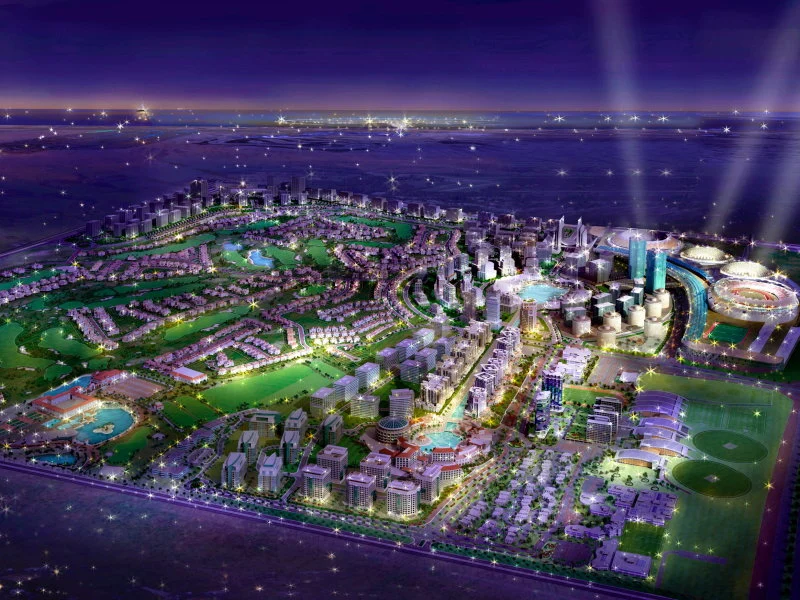
Dubailand is experiencing its most aggressive commercial resurrection since the 2008 financial freeze. New residential developments in the area now accumulate 12,000 units under active construction with deliveries scheduled between 2026 and 2028, a volume that doubles the supply of the last three years. Entering the wrong phase of this cycle can turn you into a bag holder for a decade.
The district, which for fifteen years kept dormant lands after the collapse of Dubailand Suntech, now shows cranes on every available plot. Developers like Samana and Damac launch gated communities with firm promises of equivalent infrastructure.
Dubailand’s real estate renaissance after fifteen years of dormancy
The original project contemplated 278 square kilometers of pure entertainment, but the 2008 collapse left the land in economic coma until 2019. Since then, rezoning towards residential has allowed licenses for 8,400 new homes in 2024 alone in the sector known as Living Legends. The transformation has been radical since then.
The current strategy pivots on low entry prices with promises of high rental profitability. A two-bedroom apartment is marketed at 280,000 euros compared to the 450,000 demanded by Dubai Marina, although the distance to downtown exceeds 25 kilometers without an operational metro until 2027. This price difference attracts European retail investors.
This geographical gap configures the first selection filter. Those who bought in 2023 already register annual capital gains of 18% according to municipal records, while investment funds accumulate land for 2025-2026 phases. Timing is critical because the market absorption limit is around 6,000 annual units in this microzone. Construction companies are accelerating deadlines to capture fresh capital before the correction.
Why the 2026-2028 interval defines your risk profile
The Dubai real estate market operates in supply waves linked to macroeconomic events. The 2026-2028 window coincides with post-Expo 2020 stabilization and the evacuation of Russian capital that inflated prices between 2022 and 2024. This chronology marks the differential between winning or losing.
✓ Between 2026 and 2027, projects with pre-pandemic costs and discount margins will be delivered.
✓ The Dubailand metro extension in 2027 will reduce the journey to downtown to 18 minutes, catalyst for express revaluation.
✓ 2028 closes the advantageous tax cycle for offshore investors in Dubai.
Buying pre-sale today means paying within 30 days with delivery in 36 months, exposing your capital to dirham fluctuation and developer solvency. Dubailand offers solid legal protection, but only if the contract includes a verifiable escrow account. Developer credit risk is the typically ignored factor.
The projected saturation for 2029 suggests that buying in 2028 equals acquiring at a historical maximum, the classic mistake of those who enter late into second-tier developments. The bag holder buys in 2028 believing it’s 2026.
The three mistakes that turn Spanish investors into compulsive bag holders
The first mistake consists of confusing pre-sale with guaranteed investment. Signing an SPA without a rescission clause for construction delays leaves you tied to an unfinished asset when the price curve turns bearish, especially if the developer lacks solid bank guarantee for unforeseen delays.
The second mistake is ignoring the opportunity cost of the dollar-pegged dirham. If the ECB lowers rates while the Fed maintains theirs, your euro entry becomes 8% more expensive without the asset reflecting it, thus eroding the net profitability estimated in your original calculations.
The third mistake is selecting secondary developers without track record in Dubai. A bag holder accumulates https://www.youtube.com/watch?v=tU0kvEzDyBk illiquid assets without secondary demand, such as projects that promised theme park views but deliver real estate wallpaper facing six-lane highways without soundproofing or urban compensation.
How to read between the lines of shell construction contracts before signing
Clause 7.3 of the standard Oqood contract must specify daily penalties for delays exceeding six months. If the document only mentions “force majeure” without defining time limits, you are giving a blank check to the developer.
Verify that the escrow account is domiciled in a tier-1 Emirati bank, not in Dubai offshore subsidiaries. Dubailand projects have experienced average delays of 11 months during 2023, so the bank guarantee must cover 100% of contributed capital, not just the initial 20%.
Analyze the community’s master plan. Some buildings located facing highways without projected soundproofing will see their rents fall by 30% after new access openings. The unit’s orientation determines summer energy consumption, a data point that multiplies or divides your net profitability.
The post-2028 horizon and the closing window for European capital
Market projections suggest a price consolidation after 2028, when the housing stock will reach equilibrium with real demand from skilled migrants and not speculators. Dubailand will cease to be an opportunity zone to become a mature market with returns of 3-4% annually, similar to Madrid or Barcelona.
Institutional capital is already accumulating positions to exit in 2027 through local REITs before price consolidation becomes evident to retail. Those who enter in 2026 will be able to surf the last bullish wave, but those who wait until 2029 will buy expensive in a zone without short-term capital gains.
The key lies in synchronizing your time horizon with the construction phase. If you seek real estate flip, only 2026-2027 offer margin. If you bet on stable income for ten years, the 2028 phase works with corrected prices. The trap lies in wanting both things simultaneously.