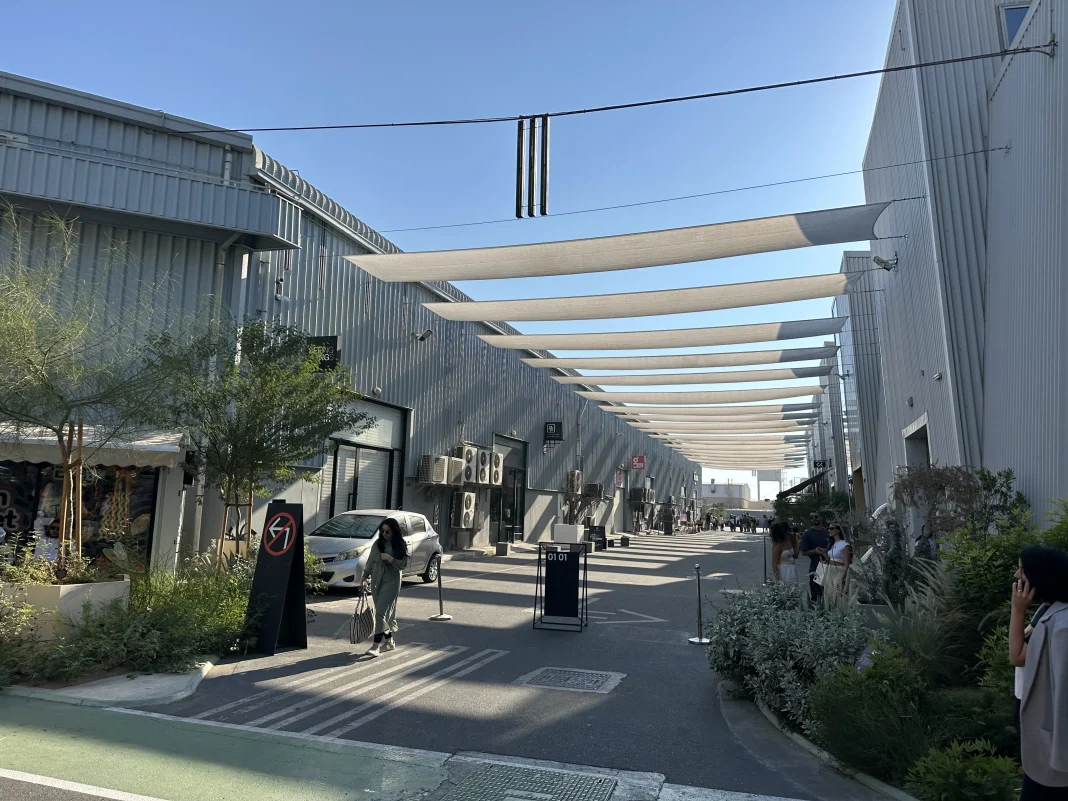


If someone tells you they have found a tropical forest in the middle of the Arabian desert, you will probably think the sun has affected them too much. However, Sobha Hartland appears just a few minutes from the Burj Khalifa with an urban anomaly that is breaking all the rules of the market: a community of 8 million square feet designed for those who hate noise but love money.
What is happening in Mohammed Bin Rashid City is not just construction, it is a statement of intent against the traditional model of overcrowded skyscrapers. Here, the priority is not height, but land: thousands of trees planted strategically to reduce thermal temperature naturally, creating a microclimate that increases the value per square meter at a dizzying speed.
Beyond concrete: the luxury of breathing
Forget about glass towers where you cannot open the windows. The big bet of this development is to dedicate almost a third of its total area to open spaces and greenery, something unheard of in a city obsessed with making use of every buildable centimeter. This is not about four poorly placed palm trees, but about real forest sanctuaries surrounding the villas.
This obsession with greenery has a very lucrative side effect: exclusivity. By reducing population density and increasing quality of life, rental demand in the area has skyrocketed, attracting expatriate families willing to pay high premiums to live in a house with a real garden.
The invisible technology that boosts the price
But do not be fooled by the bucolic appearance; under the grass there is high-speed fiber optic. The homes in Sobha Hartland come standard with home automation systems that would make the ship from Star Trek look old. From energy management to security, everything is controlled from a mobile phone, which reduces maintenance costs and increases commercial appeal for the modern investor.
This integration of “Smart Homes” is vital to understand why the projections for 2026 are so aggressive. Today’s tenant is no longer looking only for luxury, but for efficiency. And in a saturated market, offering a villa that manages itself is the difference between having it empty or having a waiting list. It is the sheikh’s vision brought to the residential field: innovation or nothing.
Profitability: the numbers that matter
Let us get to what really hurts or heals: the wallet. While other areas of Dubai stagnate, recent reports point to an ROI ranging from 8% to 10%, figures that in Europe are science fiction. If the estimated 40% capital gain over the next five years is added, this is a compound capitalization opportunity that is very difficult to ignore.
The trick is to get in before the final phase is completed. Smart investors know that the real gain is in the appreciation during construction, not just in the subsequent rent. This is what differentiates a new generation of real estate assets from simple speculation. If you have liquidity and patience, this neighborhood could be your best pension plan.
Here are two additional blocks ready to be inserted in the development, maintaining the critical tone, strategic bold text, and the focus on profitability.
The golden trap for families: elite schools
One of the best kept secrets of this development has nothing to do with bricks, but with books. Within the community’s perimeter operate two educational giants: the North London Collegiate School and the Hartland International School. This, which may seem like a minor detail, is actually an insurance policy for the landlord.
The logic is overwhelming: an expatriate family that enrolls its children in these centers (where waiting lists are the norm) will hardly move to another area. This drastically reduces tenant turnover and guarantees long-term rental contracts, eliminating those dreaded empty months that destroy the annual profitability of any novice investor.
Living between flamingos and skyscrapers
The location of Sobha Hartland is a geographical paradox that works. You are technically in the center, less than ten minutes by car from Dubai Mall, but the noise of the city disappears. The reason is its bordering neighbor: the Ras Al Khor Wildlife Sanctuary, home to thousands of pink flamingos that protects the edge of the development against new massive constructions.
Having views protected by law in a city that changes its skyline every Tuesday is a luxury that is increasing in value. This proximity to the Dubai Canal and the Meydan racecourse connects the neighborhood with the main arteries without suffering their traffic jams, creating an oasis of accessibility that very few areas of “old Dubai” can replicate today.