

Why does the world’s most demanding money keep flowing to Dubai when the rest of the markets tremble? The question is not rhetorical: in 2025, the emirate closed more than 270,000 real estate transactions, a historic record representing 20% growth compared to the previous year. We are not talking about a city in disorderly expansion, but a destination that has learned to capitalize on global uncertainty.
What distinguishes the current cycle from previous ones is the nature of the buyer. Only 5% of current buyers resell within a year, compared to 17% who did so in 2014. The speculative profile has yielded center stage to the long-term investor, and that structural shift is exactly what defines a market in the process of real maturation.
Dubai in 2026: Records Nobody Expected and Capital That Keeps Coming
In January 2026, Dubai recorded AED 72.4 billion in residential transactions, an increase of 63% compared to the same month in 2025. It was not an anomaly: it is the continuation of a trend that has held unbroken for four years, driven by high-net-worth international investors seeking predictable markets in a global environment that is not.
The market has already surpassed AED 2 trillion in cumulative transactions over the last five years, according to W Capital. Cities like London, Singapore, and Madrid compete to attract foreign capital with tax incentives, but Dubai holds an advantage in a factor that is difficult to replicate: zero property tax and zero capital gains tax.
Why Dubai Keeps Winning the Battle for European Capital in Real Estate
For the European investor, Dubai represents a radically different financial equation. While European taxation consumes between 20% and 45% of gross returns, Dubai real estate offers net yields of between 6% and 9% annually in strategic areas, with no withholdings or tax surprises after closing.
The regulatory framework reinforces that competitive advantage. Mandatory escrow accounts, the transparency of the Dubai Land Department, and foreign property rights over designated zones have made Dubai an environment of real legal security, not just perceived. In February 2026, the emirate also relaxed mortgage requirements for non-resident investors, multiplying the purchasing power of Spanish buyers who combine bank leverage with access to high-yield assets.
Prime Areas, Off-Plan, and the New Investment Map of Dubai Real Estate
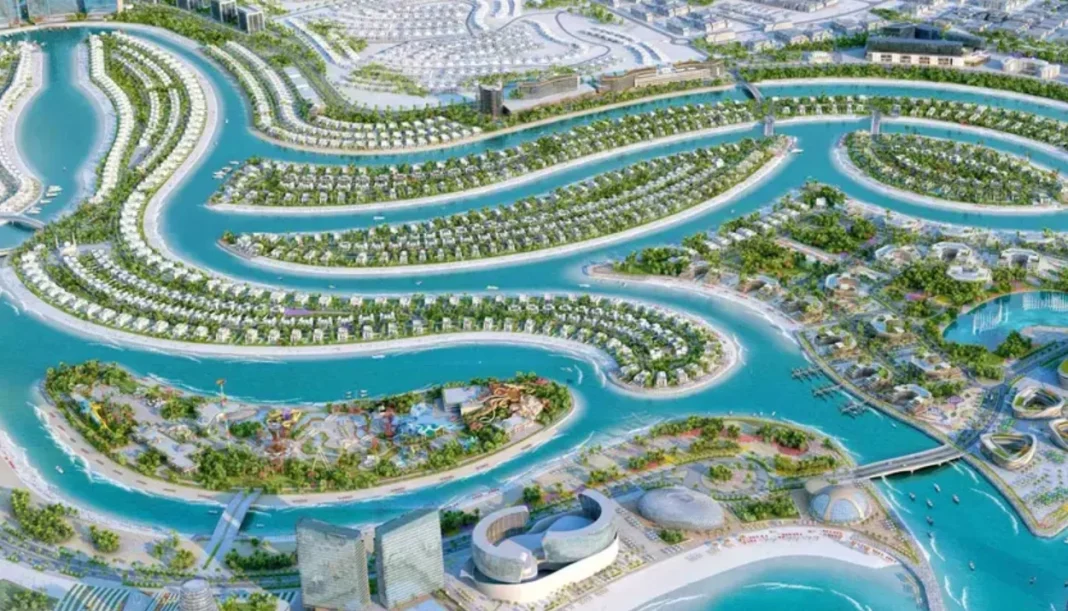
Palm Jumeirah, Downtown Dubai, and Dubai Hills Estate concentrate the bulk of high-value transactions in the first quarter of 2026. Off-plan developments, with installment payment plans during construction, have become the favorite entry point for the upper-middle international investor: they allow capital to be committed gradually while the asset appreciates before delivery.
In the more accessible segment, areas such as Dubai Silicon Oasis and Jumeirah Village Circle offer studios from $88,000 with stable net yields between 8% and 8.5%. The diversity of entry profiles is one of Dubai’s strongest arguments compared to other luxury markets: it does not require a minimum ticket of several million to participate in the emirate’s upward cycle.
Geopolitics and Resilience: Dubai Holds Where Other Markets Break
In March 2026, Iranian drones struck near Dubai’s international airport. Four days later, the port of Jebel Ali — which generates 60% of the emirate’s revenue — was operating at full capacity. The speed of logistical and commercial recovery of the emirate is, in itself, the most powerful argument for the skeptical investor.
High-value transactions closed during that period without significant discounts, evidencing investor conviction in long-term fundamentals. The decoupling between regional geopolitical volatility and price per square meter is not accidental: it is the result of years of strict regulation and an economic model that has learned to neutralize external noise without altering its internal structure.
| Indicator | 2025–2026 Data | Reference |
|---|---|---|
| Total transactions 2025 | 270,000+ (+20% year-on-year) | Dubai Land Department |
| January 2026 transactions | AED 72.4B (+63% year-on-year) | Dubai Land Department |
| Net rental yield | 6% – 9% annually | Strategic prime areas |
| Expected prime segment growth | +3% in 2026 | Knight Frank |
| Buyers reselling in <1 year | Only 5% (vs. 17% in 2014) | GetStake / market analysis |
Dubai 2027 and Beyond: The Market That Bets on Stability Over Illusion
Knight Frank projects 3% growth in the prime segment during 2026, with the upward trend holding in the mid-range segment despite the arrival of approximately 120,000 new units to the market. Absorption remains robust because Dubai’s population already exceeds 4 million inhabitants and continues growing at a pace that outstrips construction. Between 2026 and 2030, 331,000 new homes will be completed according to Knight Frank, but structural demand shows no signs of exhaustion.
For the investor evaluating Dubai in 2026, the clearest advice circulating among sector analysts is: prioritize quality assets in consolidated areas, bet on sustainable returns over speculative appreciation, and do not confuse price moderation with market weakness. A market that matures does not collapse — it simply stops running to learn to walk fast for much longer.