


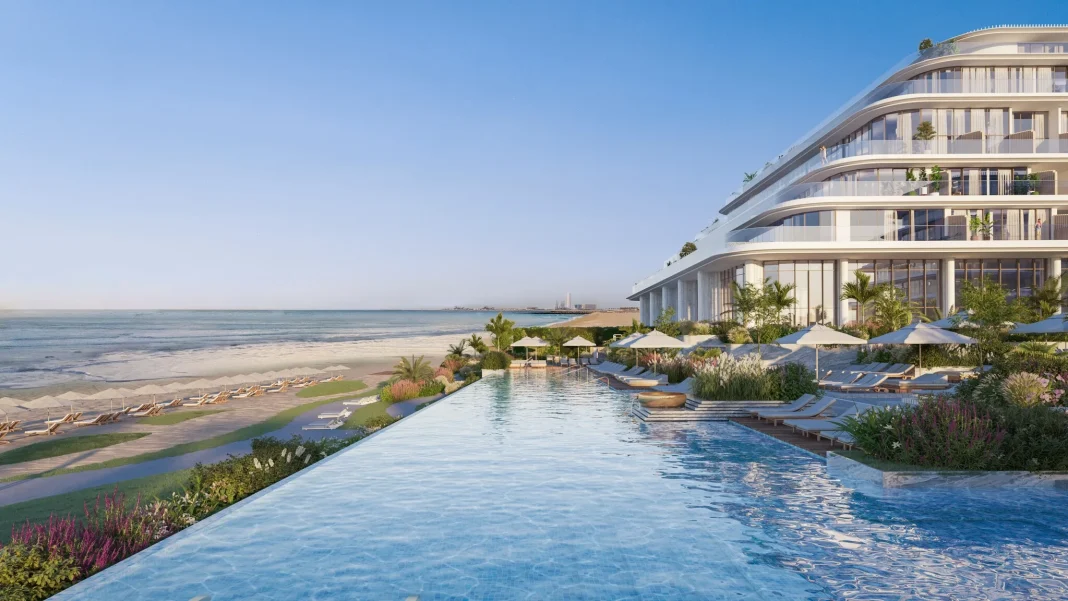
Can Meliá and Riu continue to surprise in a destination where the world’s most luxurious facilities already exist? That is the question asked by Spanish hotel executives whenever they land in Dubai, an emirate that already boasts a hotel with a helipad–tennis court, the tallest skyscraper on the planet and floating resorts on artificial islands. And yet, the two major Spanish chains are here, making a strong bet on a market that does not forgive mediocrity.
Meliá has confirmed the opening of the Gran Meliá Dubai Jumeirah on December 1, 2026, its most ambitious project in the Middle East. Riu, for its part, has been operating in Dubai Islands for years with a 24‑hour all‑inclusive model that has turned its hotel into one of the most highly rated in the emirate. Two different strategies, one same territory: Arabian luxury.
Why Meliá Chose Jumeirah for Its Big Bet in Dubai
It is no coincidence that Meliá has positioned its new flagship hotel in Jumeirah 1. Port de La Mer is the new epicentre of residential and resort luxury in Dubai, an area combining a private marina, a white‑sand beach and direct views of the skyline. The Gran Meliá Dubai Jumeirah will feature 380 rooms and suites designed by MOMA, desertINK and Lagranja, a combination of international architecture that aims to redefine the concept of an urban resort.
The model chosen by Meliá for this project is that of hotel management: the real estate owner is Albwardy Investment LLC, the same group with which the Spanish chain already operates seven properties in Tanzania, Argentina, the United Kingdom and Dubai itself. This structure reduces financial risk and allows Meliá to focus on what it does best: selling a Mediterranean experience at Asian luxury prices.
The Meliá Desert Palm: The Other Hotel That Already Defines Spanish Luxury in Dubai
Before the Gran Meliá Dubai Jumeirah, Meliá had already demonstrated in Dubai that Mediterranean luxury works in the desert. The Meliá Desert Palm is an exclusive resort with its own polo field, one of the few properties of this type in the entire Middle East. Its existence shows that Meliá’s strategy in the emirate is not new: the chain has been building a reputation in the premium segment since 2018.
This accumulated story is precisely the argument the chain uses to justify the investment in Jumeirah. Someone booking at the new Gran Meliá Dubai is not betting on an unknown brand in the destination, but on a hotelier with years of proven operation just a few kilometres away. In a market as competitive as Dubai, that track record is worth more than any marketing campaign.
Riu in Dubai Islands: The All‑Inclusive That Conquered the Desert
While Meliá prepares for its major opening, Riu has been solidifying a strong presence in Dubai Islands—the former Deira Islands—for several years. The Hotel Riu Dubai operates with the All‑Inclusive 24 Hours system, a format that at first seems at odds with a destination so focused on external gastronomy and street‑level experiences. And yet, it works.
With more than 750 rooms, the Splash Water World water park, a spa, aqua‑bars and direct beach access, Riu has built a closed, self‑sufficient product that attracts a different type of traveller to the boutique‑luxury segment: families, groups of friends and couples who want Dubai without logistical complications. A huge segment that the ultra‑luxury chains do not cover.
What Differentiates Meliá and Riu in Their Expansion Model in the Emirates
The expansion of both chains in the Emirates reflects two distinct philosophies for understanding international growth:
| Criterion | Meliá | Riu |
|---|---|---|
| Business model | Hotel management (no real‑estate risk) | Direct hotel ownership |
| Target segment | Luxury and upper‑luxury (Gran Meliá, ME) | Mass holiday (All‑Inclusive) |
| Opening 2026 | Gran Meliá Dubai Jumeirah (Dec 2026) | Already operating in Dubai Islands |
| Property owner | Albwardy Investment LLC | Grupo Riu |
| Hotel capacity in Dubai | 380 rooms and suites | More than 750 rooms |
| Local partnerships | UAE investment fund | No declared local partner |
While Meliá prioritises management without direct investment, betting on brand luxury and signature gastronomy, Riu trusts direct ownership and a high‑volume holiday product. Both models are profitable, but they respond to different moments in the economic cycle and to completely different risk profiles.
What Comes Next: Meliá Aims for 28 Openings in 2026 and the Gulf Looks to Saudi Arabia
The opening of the Gran Meliá Dubai Jumeirah is just one piece of a global plan that envisages 28 inaugurations by Meliá in 2026, its 70th anniversary year. Bali, the Seychelles, the Maldives, a renewed Cancún and several hotels in Spain form part of an unprecedented rollout for the Mallorcan chain. The pattern is clear: sun destinations, luxury and differentiated experiences, always under management models that minimise financial exposure.
Experts’ advice for anyone wanting to understand where Spanish luxury tourism in the region is heading is simple: look at Saudi Arabia. The Neom plans, the new coastal zones along the Red Sea and Mohammed bin Salman’s strategy to diversify the Saudi economy are creating hotel‑management opportunities similar to those of Dubai fifteen years ago. Meliá and Riu are already exploring this territory. The desert has much more to offer.