

What if everything you thought you knew about Abu Dhabi as an investment destination was only half the story? For years, the UAE capital was seen as Dubai’s older, more conservative sibling — a solid but closed market, reserved for sheikhs and large institutional funds. The 2025 data blows that narrative apart completely.
The official report from the Abu Dhabi Real Estate Centre published in February 2026 leaves no room for doubt: foreign buyers — both residents and non-residents — accounted for 62% of the total value of residential sales in Abu Dhabi in 2025. In absolute terms, the market closed the year with transactions worth AED 76 billion in residential alone, quadrupling the figures recorded in 2022.
Abu Dhabi, Capital of Foreign Investment in the Emirates
The transformation of the market has not been gradual — it has been an explosion. Non-resident buyers have multiplied their acquisitions in Abu Dhabi by twelve between 2019 and 2024, a figure unmatched by any other real estate market in the region. Behind this growth lies a structural shift: the opening of freehold investment zones where any foreigner can buy outright without needing a local partner.
In parallel, the government has reinforced incentives with long-term visas of up to ten years for minimum investments of AED 2 million. This has turned Abu Dhabi into more than just a market: it is now a legal gateway to UAE residency, and buyers from 97 different nationalities have already crossed that threshold.
Saadiyat, the Island Capturing 34% of Foreign Capital
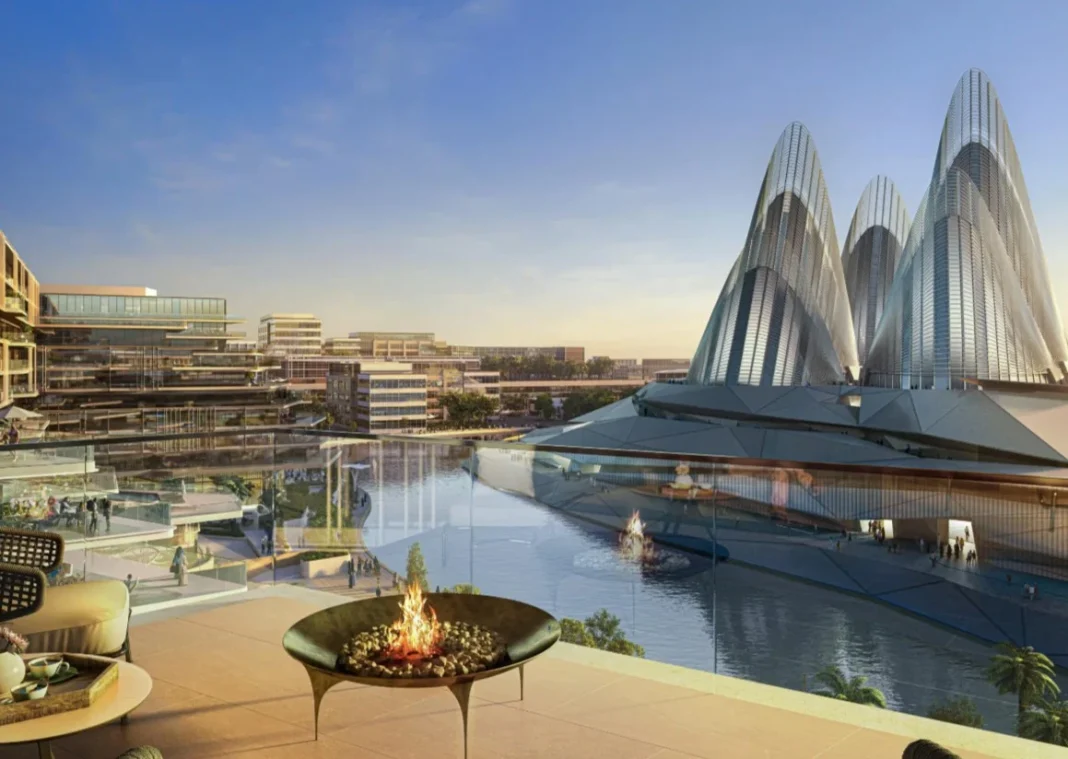
If there is one zone that explains the investment phenomenon in Abu Dhabi, it is Saadiyat Island. With the Louvre, the future Guggenheim, and the National Museum of the Emirates as neighbors, Saadiyat concentrates 34% of all foreign direct investment in the emirate. It is not just luxury: it is an urban project with a cultural narrative that no other district can replicate.
Prices on Saadiyat have responded accordingly. The average value per square meter in Abu Dhabi rose 16% year-on-year in the third quarter of 2025, but in Saadiyat’s premium enclaves the differential is even greater. For the international investor, the island functions as a safe-haven asset with appreciation potential — something rare in a global market full of uncertainty.
Yas, Al Reem and Al Jurf: Abu Dhabi’s Completing Podium
Yas Island takes second place with 28% of foreign investment. Its combination of theme parks, Formula 1 circuit, and high-end residential developments has made Yas the family and aspirational destination par excellence in Abu Dhabi. Apartments — which represented 78% of total transactions in 2025 — have their highest concentration of international buyers here.
Al Reem Island accounts for 11% of foreign capital and consolidates its role as an upper-middle-class urban corridor. Al Jurf, with 12%, surprises with its rapid rise: this coastal development straddling Abu Dhabi and Ajman has attracted investors seeking more accessible prices with a high appreciation profile. Al Shakha rounds out the podium with 8% of the total.
The International Money Moving Abu Dhabi in Numbers
| Zone | % Foreign Investment | Buyer Profile |
|---|---|---|
| Saadiyat Island | 34% | Luxury, culture, long-term |
| Yas Island | 28% | Family, lifestyle, off-plan |
| Al Jurf | 12% | Accessible, high appreciation |
| Al Reem Island | 11% | Urban, upper-middle class |
| Al Shakha | 8% | Emerging, first purchase |
The total foreign investment in Abu Dhabi real estate grew 66% to AED 35 billion in the first nine months of 2025. In the same period, foreign direct investment in the real estate sector exceeded AED 6.2 billion, 35% more than the previous year. The market closed 2025 with a record total transaction volume of $38.7 billion, 44% above 2024.
Abu Dhabi in 2026: Rising Prices and Boundless Demand
Forecasts for Abu Dhabi in 2026 point to acceleration. ValuStrat projects a 16% rise in residential values, compared to 13% in 2025, with apartments outpacing villas in appreciation for the first time. Residential occupancy is expected to reach 90%, maintaining upward pressure on prices and rents across all sub-markets.
Analysts’ advice is clear: anyone looking to enter Abu Dhabi should do so before the 6,500 new units expected for 2026 are absorbed by the market — a process that, given current demand, is expected to happen faster than official timelines suggest. The window to enter at a competitive price in Yas, Saadiyat, and Al Reem is closing.