

Financial Market of Dubai and Abu Dhabi Exchange show rebound after weekend crisis
One trillion dollars in assets frozen for 48 hours: that is how the week opened in Dubai for thousands of investors who on Sunday night still did not know whether they would be able to trade on Monday. The attacks by Iran on the United Arab Emirates over the weekend of February 28 forced the Capital Market Authority to completely shut down the Dubai Financial Market and the Abu Dhabi Exchange for two consecutive sessions, on March 2 and 3.
What followed was not the collapse many had feared. The reopening on Wednesday, March 4 brought selling, yes, but also confirmation that Dubai’s market fundamentals remain intact and that the pattern of Saudi recovery —which went from falling 5% to regaining gains in two days— is already serving as a roadmap for investors in the emirates.
Why Dubai closed its exchange for two days in a row
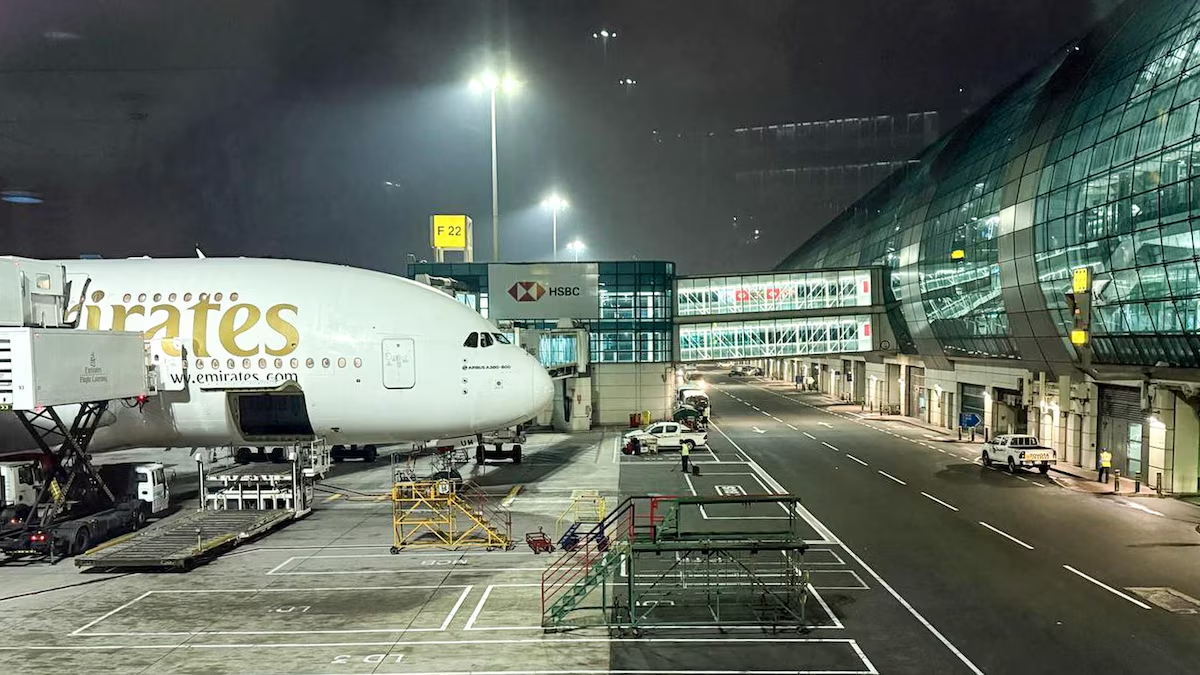
The UAE Capital Market Authority took a decision without recent precedent: to abruptly halt trading on March 2 and 3 amid the escalation of the conflict in the Middle East. The Iranian attacks affected airports, ports and residential areas in Dubai and Abu Dhabi, pushing uncertainty to levels incompatible with an orderly session.
The move was not only protective for local investors. With a combined capitalization of 1.1 trillion dollars between the DFM and the ADX, and with Dubai as the only major Gulf market with a high share of foreign capital, allowing the accumulated orders to execute unchecked would have disproportionately amplified panic selling.
Dubai and Abu Dhabi reopened Wednesday with controlled losses
On Wednesday, March 4 the markets resumed trading with a technical limit of a maximum 5% decline per stock. The benchmark index of the Dubai Financial Market fell 4.71%, its biggest drop since May 2022, while the ADX lost 1.93%, trimming an initial 3.6% slide. Emaar Properties, Emirates NBD and Salik hit that technical floor immediately after the open.
The key was not the drop but the containment. Listed companies publicly confirmed that their operations continued without material impact. Materials was the only sector in positive territory, with a 2.38% gain led by National Cement Company, a sign that capital has not abandoned Dubai but rather repositioned. The stock market thus demonstrated its operational maturity even under extreme conditions.
The rebound: how investors are reacting this week
After the initial blow on Wednesday, Dubai staged a recovery of more than 7% in the next session, erasing a large part of the accumulated losses. This move follows the script set by the Saudi market, which absorbed the initial shock and moved to gains in just two days, supported by oil prices and the perception that the conflict would not escalate beyond what had already occurred.
Gulf analysts note that outflows were concentrated in real estate and financials, the sectors with the largest presence of expatriate capital. However, Dubai’s market is proving to have a more diversified and resilient investor base than the initial panic suggested, with buyback orders activating at levels many managers had been waiting for months.
Key sectors and stocks in Dubai after the crisis
| Sector / Stock | Opening move (4 March) | Subsequent trend |
|---|---|---|
| Emaar Properties | -4.94% (15.4 AED) | Partial rebound |
| Emirates NBD | -5% (technical floor) | Stabilisation |
| Dubai Islamic Bank | -4% | Moderate recovery |
| National Cement | +2.38% | Sustained positive |
| DFM (benchmark index) | -4.71% | +7% next session |
| ADX (Abu Dhabi) | -1.93% | Progressive improvement |
Dubai and its market in the coming weeks: what to expect
Gulf market analysts agree that Dubai maintains its solid fundamentals. The DFM index had risen more than 29% in the year prior to February 27, reaching highs not seen since 2006, and that struct