

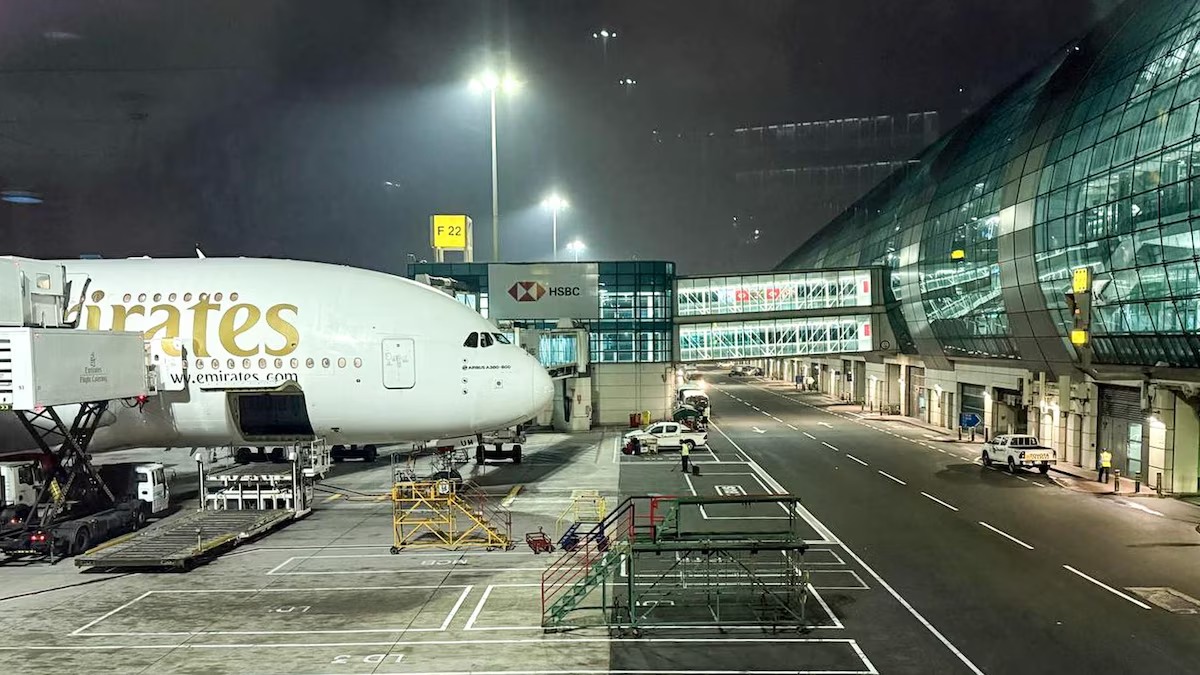
More than 20,000 passengers have spent days sleeping on the floors of Dubai’s terminals. The world’s busiest airport for international passengers, famed for never closing and operating 365 days a year without interruption, slammed on the brakes on 28 February after the military escalation between Iran, the United States and Israel. The closure of United Arab Emirates airspace stranded everyone holding a plane ticket.
2 March marked a turning point: Dubai International (DXB), Dubai World Central (DWC) and Abu Dhabi’s Zayed International Airport resumed operations on a limited basis, with a single priority objective: to get those passengers out of the terminals and back home. What looked like a return to normality is, in reality, a large‑scale global emergency operation.
Dubai at a standstill: how the global hub reached this point
In the early hours of 28 February, the UAE’s air‑defence systems intercepted more than 100 drones and missiles aimed at critical national infrastructure, including Dubai Airport itself. Four workers were injured in the northern area of the airport complex, forcing authorities to order an immediate, total closure of the airspace.
Operations ground to a complete halt. Emirates and flydubai cancelled more than 400 scheduled flights in a matter of hours. Air Arabia, Etihad and dozens of international airlines did the same. The air corridor linking Europe with Asia, Africa with the Americas and Oceania with everywhere was cut off at a stroke, triggering an unprecedented logistical collapse in global civil aviation.
Dubai’s limited reopening: what it means in practice
From 18:00 local time on Monday 2 March, Dubai Airports confirmed a partial resumption of operations at DXB and DWC with flow restrictions on both departures and arrivals. This is not a return to normal: slot coordinator ACL wiped the entire flight schedule for 3, 4 and 5 March so that airlines could request new time slots based on their real capacity.
Emirates confirmed it would operate a limited number of repatriation and cargo flights, giving priority to passengers with the oldest bookings. The airline also allowed travellers to rebook free of charge until 20 March or request a full refund. Passengers were explicitly warned: “Do not go to the airport unless your airline has confirmed a validated departure time.”
Abu Dhabi launches exceptional flights to repatriate nationals
[https://www.youtube.com/watch?v=YzDZisnUiTI](https://www.youtube.com/watch?v=YzDZisnUiTI)The UAE General Civil Aviation Authority authorised the operation of exceptional flights at Abu Dhabi Airport (AUH) from 2 March, in coordination with airlines and local authorities. Etihad Airways, Abu Dhabi’s flag carrier, also resumed repositioning, cargo and repatriation services under strict safety and operational‑approval conditions.
The first 175 Spanish citizens evacuated from the Middle East landed at Adolfo Suárez Madrid–Barajas Airport on flights from Abu Dhabi. Emirati authorities covered expenses for passengers affected by the airspace closure, providing hotel accommodation, meals and support services while they waited for their outbound flights.
Numbers behind the chaos: what 72 hours of paralysis in Dubai left behind
| Indicator | Recorded figure |
|---|---|
| Flights cancelled at DXB (2 March) | 227 of 236 scheduled by Emirates |
| Regional flights cancelled that day | 1,560 (41% of global total) |
| Seats affected per day | ~900,000 |
| Accumulated stranded passengers | 20,000+ |
| Missiles and drones intercepted (28 Feb – 4 Mar) | 186 missiles + 812 drones |
| Injured at Dubai Airport | 4 (ground staff) |
| Passengers through DXB in 2025 | 95.2 million |
Dubai and its airport: when to expect normalisation and what to do if you have a flight
Operational recovery in Dubai will be neither quick nor smooth. Although the partial reopening is a positive sign, aviation experts warn that aircraft and crews are out of position across the global network, which will cause knock‑on delays for days or even weeks. Long‑haul transcontinental routes will be the last to normalise because of the logistical complexity of repositioning fleets.
If you have a flight connecting through or bound for Dubai or Abu Dhabi in the coming days, the advice is clear: do not move until you have direct written confirmation from your airline. Check your flight status every few hours via official channels, keep all receipts for extraordinary expenses (hotel, meals) because airlines are required to reimburse them under many jurisdictions, and consider alternative routings via Turkey, Qatar or Europe if your trip is urgent.