

Security in Abu Dhabi endured last weekend the largest air attack in its recent history: 812 Iranian drones detected in four days, of which 755 were intercepted and 57 reached Emirati territory.
No collapse followed. Nor was there silence: the explosions from the interceptions shook residential neighborhoods in the capital, and residents woke up with the certainty that the Persian Gulf is no longer immune to anything.
The Ministry of Defence confirmed a 93% drone neutralization rate and a 92% rate for ballistic missiles.
These figures place the Emirati air shield among the most effective on the planet. However, those same numbers conceal an uncomfortable truth: each successful interception generates shrapnel that falls over the cities, and that shrapnel also kills.
Security in Abu Dhabi faces its toughest test in decades
Since 27 February, the armed forces of the United Arab Emirates activated a layered defence protocol that had not operated at this scale since the country’s founding.
F-16 Block 60 and Mirage 2000-9 fighters intercepted threats at range, while short-range ground systems covered blind spots over critical infrastructure. The capital did not shut down. Its airports, ports and free zones continued operating under maximum alert.
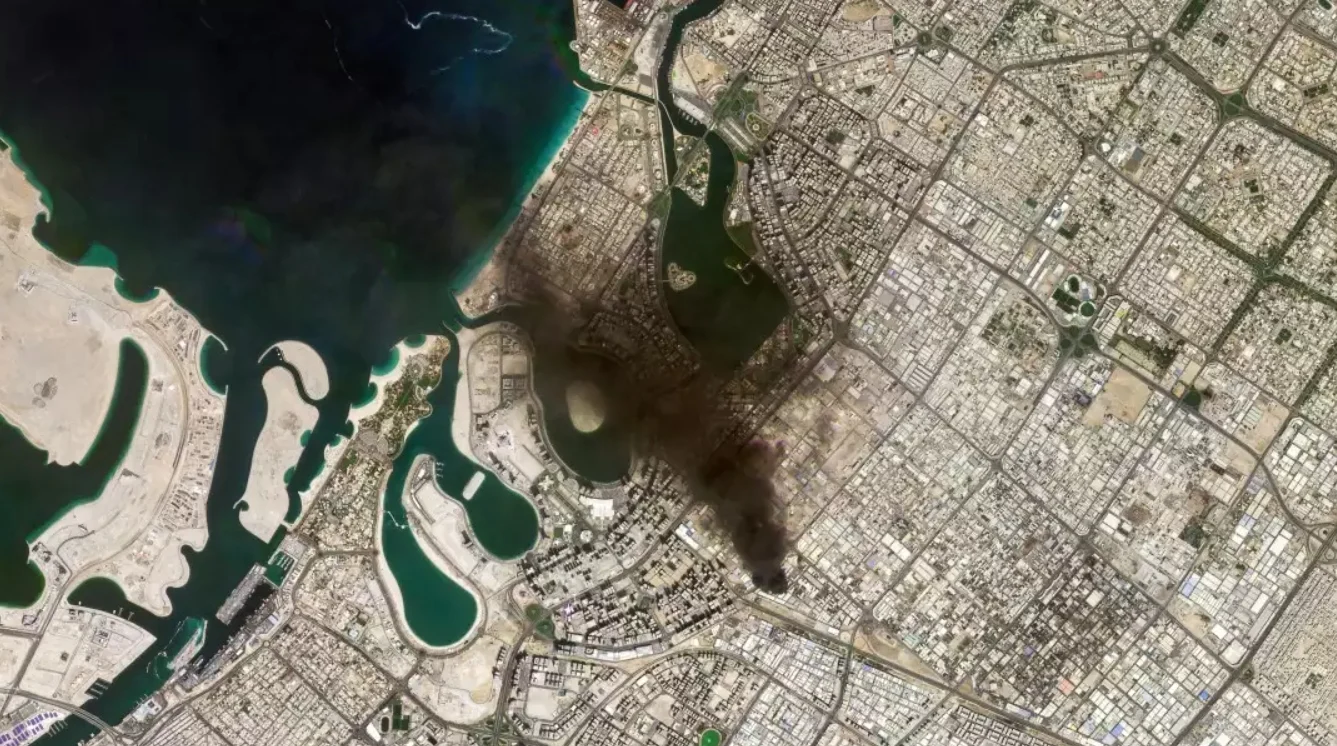
Zayed International Airport did not emerge unscathed: shrapnel from a downed drone struck the premises, causing one fatality and seven injuries.
In Mussafah and ICAD, industrial facilities suffered minor damage from interception debris. Security in Abu Dhabi proved it can contain a massive offensive; it also showed that “containing it” does not mean “neutralizing it” without consequences.
The Shahed drone: the weapon that upends the Gulf’s equation
The central weapon in the Iranian offensive was the Shahed-136: triangular shape, low-altitude flight, a range of up to 2,500 kilometres and a unit cost below 20,000 dollars.
Against interceptors that cost several millions, the math is devastating: Iran can saturate Gulf airspace at a pace that no conventional defence system can match economically. Alongside the Shahed-136, Iranian forces deployed the Shahed-107, designed for high-value targets and harder to detect due to its reduced radar signature.
Security in Abu Dhabi thus faces a threat that is asymmetric by definition: each Shahed shot down consumes interception resources that multiply its production cost by a factor of one hundred.
Brigadier General Abdul Nasser Mohammed al-Humaidi stressed at a press conference that the Emirates has strategic ammunition reserves sufficient to sustain prolonged operations. The message was political as much as military: Abu Dhabi does not negotiate under aerial saturation pressure.
Four days of conflict: what the real numbers reveal
Four consecutive days of attacks, with daily volumes of between 148 and 209 drones detected per day, forced Emirati defence systems to operate without pause.
By the close of Wednesday 4 March, the official cumulative tally reached 189 ballistic missiles launched —175 destroyed, 13 fallen into the sea, one impact on land—, 941 drones identified and 876 neutralized. Three people killed and 78 lightly injured make up the human cost of a campaign that the government described as “a flagrant Iranian aggression”.
In Ras Al Khaimah, an emirate that had never recorded an incident of this kind, interception debris fell in the Al Hamra area without causing casualties.
A tennis tournament in Fujairah was suspended due to a fire triggered by debris. Airports across the region diverted flights for hours. The technical victory of the defence systems and the real damage to daily life coexisted in the same Gulf sky.
The invisible cost of a successful interception
| Campaign indicator | Cumulative figure (4 days) |
|---|---|
| Iranian drones detected | 941 |
| Drones intercepted | 876 |
| Interception rate (drones) | ~93% |
| Ballistic missiles intercepted | 175 |
| Interception rate (missiles) | ~92% |
| Deaths in UAE | 3 |
| Injured in UAE | 78 |
| Drones that reached territory | 65 |
Each interception over populated areas generates a cloud of shrapnel and debris that falls uncontrollably onto buildings, vehicles and people.
This is the paradox that even the world’s most sophisticated defence systems have not solved: downing the drone saves critical infrastructure, but the debris from the shootdown can kill someone in the street below. In Abu Dhabi, that paradox stopped being theoretical last weekend.
Emirati authorities urged the population to obtain information only from official sources and to avoid spreading rumours.
They clarified that the noises reported in various parts of the capital were “a direct consequence of interception operations” and not of direct impacts from Iranian projectiles. It is a technically correct distinction that, for those living under those explosions, is hard to perceive.
Security in Abu Dhabi in 2026: outlook and advice for investors
The political and military response of the United Arab Emirates has followed a clear script: maximum transparency on interception figures, minimal information on damage to critical infrastructure and a constant message of operational normality aimed at markets and investors.
Dubai did not close its stock exchanges. Abu Dhabi did not declare a state of emergency. Cranes kept rotating over new investment districts in the Emirati capital, and lease contracts in prime areas did not register mass cancellations in the days of the conflict.
For those who have or plan to have assets in the Gulf, geopolitical risk analysts’ advice is unanimous: diversify across emirates, prioritise contracts with force majeure clauses updated to asymmetric conflict scenarios and do not confuse the robustness of the air shield with the total absence of risk.
Security in Abu Dhabi is real, proven and audited in real time. But in 2026, even 93% effectiveness leaves a 7% margin for the unexpected.