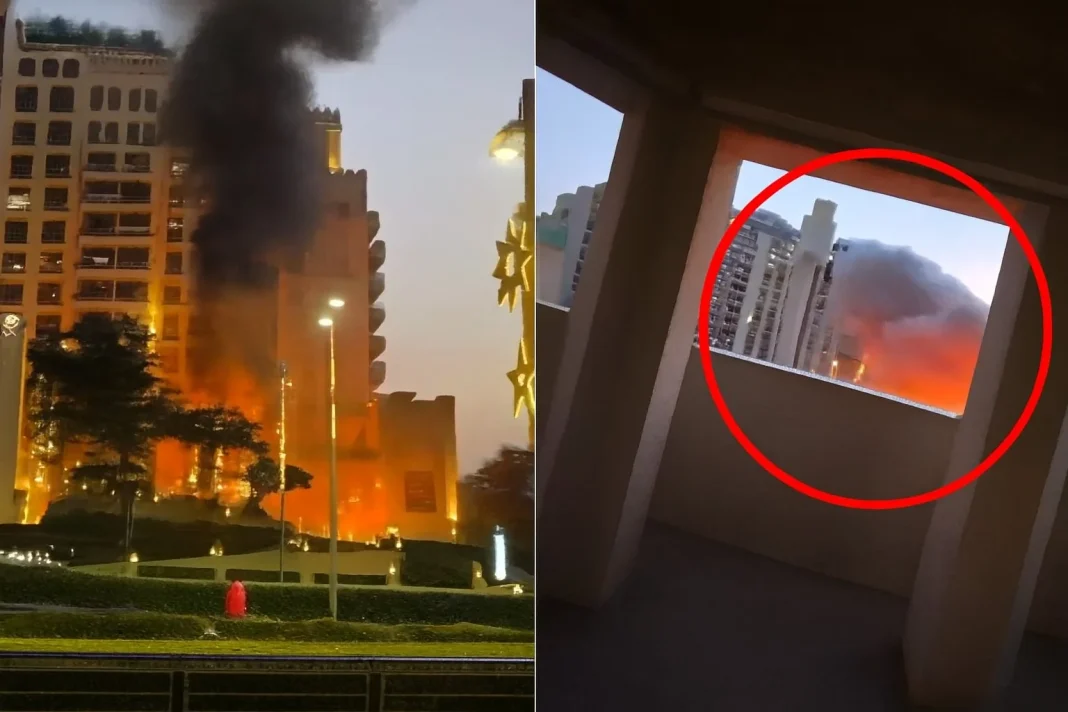


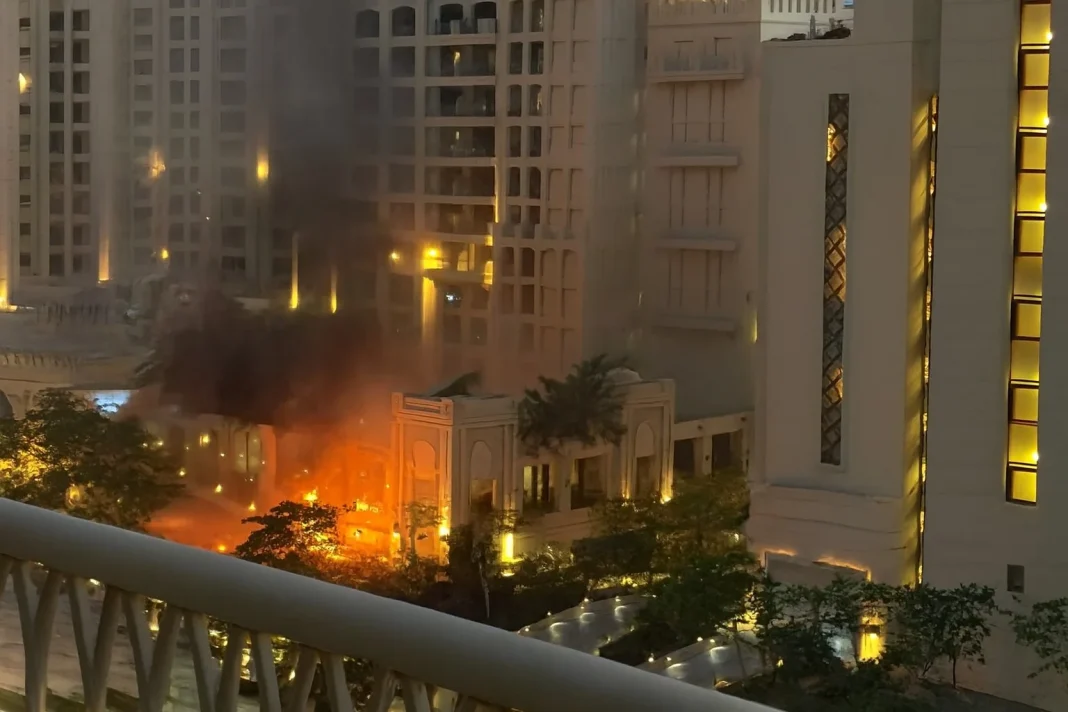
United Arab Emirates authorities confirmed this Saturday the interception of multiple aerial vectors directed toward critical infrastructure and residential areas, following a large-scale offensive launched by the Islamic Republic of Iran. The incident with the greatest media impact was located in the Palm Jumeirah area, specifically in the vicinity of the Fairmont The Palm hotel, where the impact of fragments from an intercepted missile caused a structural fire and injuries to four civilians. This event is part of a coordinated retaliation by Tehran against positions linked to Western interests in the Gulf, following preemptive bombings carried out by the United States and Israel hours earlier.
The city of Dubai, the region’s financial and logistical epicenter, has activated its state-of-the-art defense protocols in what is considered the greatest test of its national security in the last decade. The Emirati Ministry of Defense reported that its air defense systems neutralized most threats, although the falling debris in high-density tourist areas like Palm Jumeirah underscores the vulnerability of urban centers to high-intensity conflicts. This instability scenario has led to the preemptive closure of airspace and the suspension of operations at Dubai International Airport, affecting global connectivity on a critical date for international trade.
Air Defense Intervention and Fire Control in Palm Jumeirah
The Dubai Civil Defense Department deployed rapid response units following the explosions detected in the artificial archipelago. According to technical reports from firefighters, the fire at the Fairmont complex was contained in less than sixty minutes, preventing the flames from affecting the structural integrity of the main building. Authorities emphasized that the immediate priority was the evacuation of guests and the transfer of the four injured individuals to hospital centers, where they are in stable condition under medical observation.
The effectiveness of the interception systems prevented a direct impact that would have resulted in catastrophic damage to Dubai’s infrastructure. However, the fall of large metal fragments in pedestrian areas highlights the collateral risk of electronic and missile warfare in compact urban environments. The local government has urged the population to remain indoors and follow official channels while a security sweep is conducted to search for unexploded projectile remains along the coast.
Operational Deployment of the Revolutionary Guard in the Strait of Hormuz
The Revolutionary Guard claimed responsibility for the launches, arguing it was a legitimate response to external aggression against their national sovereignty. The deployment of this military body included the use of short-range ballistic missiles and suicide drones launched from mobile platforms, seeking to saturate the defense systems of the Gulf Cooperation Council (GCC) countries. In the specific case of Dubai, the objective appears to have been the disruption of economic activity and a demonstration of strike capability against foreign investment hubs.
Military intelligence analysts suggest that the Revolutionary Guard used swarm tactics to complicate the work of the Patriot and THAAD batteries deployed in the region. Although most U.S. military targets in the area were successfully protected, the indirect impact on Dubai generates immediate political pressure on security alliances in the Gulf. Iran’s ability to project force simultaneously on multiple fronts alters the risk calculation for international corporations headquartered in the Emirates.
Suspension of Logistical Activities and Regional Airspace Closure
The impact on Dubai’s operations was immediate, with the cancellation of more than 200 flights scheduled for February 28, 2026. Emirates and Flydubai airlines issued joint statements reporting service interruptions due to the closure of airspace in the United Arab Emirates and Iraq. This measure responds to the need to ensure passenger safety against the risk of new barrages of projectiles crossing the world’s busiest commercial air corridors.
In addition to the aviation sector, port activities in Jebel Ali have been put on high alert, limiting the movement of cargo ships due to the possibility of incidents in territorial waters. The disruption of the supply chain from Dubai has direct repercussions on hydrocarbon and consumer goods markets, raising risk premiums for maritime transport in the Strait of Hormuz. Economic authorities are currently evaluating the daily cost of this logistical paralysis for the local Gross Domestic Product.
Impact on Financial Markets and International Investor Confidence
Volatility in local markets manifested after the first reports of explosions in Dubai, reflecting the sensitivity of foreign capital to direct threats to civilian infrastructure. The regional stock index recorded a significant drop at the opening, with special emphasis on the real estate and tourism sectors, which represent fundamental pillars of Emirati economic diversification. Institutional investors have begun to reassess their positions given the possibility that the conflict could turn into a prolonged war of attrition.
Despite the robustness of the Emirates’ fiscal reserves, the perception of Dubai as a safe haven for global capital is challenged by its geographical proximity to the theater of operations. The government has reinforced messages of stability, ensuring that critical infrastructure has not suffered permanent damage affecting the operational continuity of basic services. However, the persistence of the threat from Iran keeps growth projections for the second quarter of the year in suspense.
| Economic Indicator / Technical Data | Value / Status (Feb 28, 2026) | Variation / Observation |
|---|---|---|
| Brent Crude Price (USD) | $94.50 | +6.2% in 24 hours |
| Cancelled Flights (DXB/DWC) | 215 operations | Temporary total suspension |
| Confirmed Civilian Injuries | 4 people | Stable condition |
| Airspace Status | CLOSED | Review every 6 hours |
| Dubai Financial Market (DFM) | -4.8% | Drop due to geopolitical risk |
Analysis of Repercussions and Structural Impact
The indirect attack against Dubai marks a turning point in the security dynamics of the Persian Gulf, demonstrating that political neutrality does not guarantee immunity against modern missile technology. The Revolutionary Guard’s ability to force the closure of critical infrastructure by saturating air defenses obliges the United Arab Emirates to deepen its technological integration with multi-layered defense systems. Structurally, this event accelerates the transition toward a more aggressive regional security architecture, where deterrence is no longer limited to foreign military presence.
In the long term, Dubai’s stability will depend on its ability to shield its economic assets from the repercussions of the rivalry between Iran and its adversaries. The impact on Palm Jumeirah, though limited in casualties, serves as a reminder that the prosperity of international financial centers in the Middle East is intrinsically linked to the regional balance of power. The international community is now watching the diplomatic and military response from Western allies, which will determine whether this incident remains an isolated event or the prelude to a forced realignment of the geopolitical chessboard.