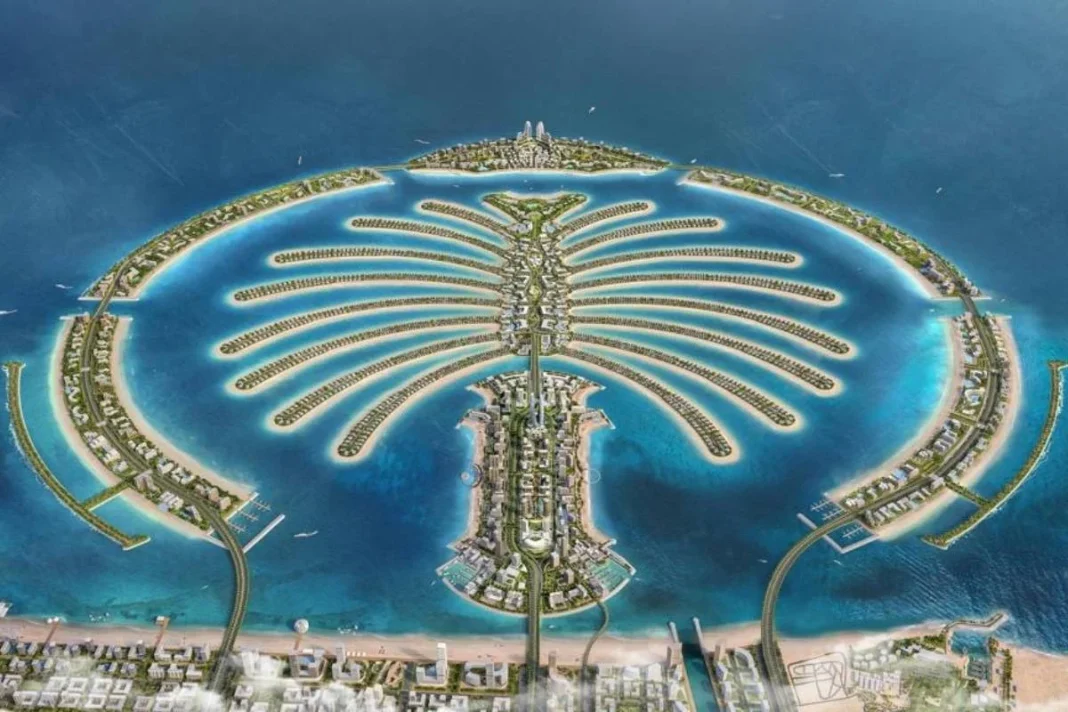


Eagle Hills has poured 800 million dollars into the first phase of Ramhan Island, a project that many analysts consider risky because it is a development in waters that are still not consolidated within Abu Dhabi’s real estate market. However, the firm has opted for this specific destination over more stable alternatives in mature markets in Europe or North America. The decision responds to a precise calculation: the expected return in this ultra-premium segment far exceeds what is offered by saturated markets where profit margins have already been dramatically compressed.
The financial architecture behind the 800 million
Eagle Hills’ investment in Ramhan Island has not been financed through a single outlay, but rather through a tiered capital structure that combines equity, senior bank debt and contributions from institutional investors who have acquired minority stakes in the project’s dedicated investment vehicle. This architecture allows the developer to maintain operational control while distributing risk among multiple financial actors with an appetite for exposure to the Emirati market. In addition, the aggressive off-plan sales model has generated an early cash flow that reduces the need for external leverage in later phases.
European pension funds, particularly from the Netherlands and Switzerland, have expressed interest in participating as limited partners in the structure, attracted by the expected 18–22% annual return over a five-year horizon. This return contrasts with the 4–6% offered by commercial real estate assets in markets such as Berlin or Paris, where competition has inflated prices and squeezed margins. For this reason, Eagle Hills has managed to position this project as a geographic diversification opportunity for investors seeking alpha in high-growth emerging markets.
Why Abu Dhabi and not more established markets
The choice of Abu Dhabi as the epicenter of this investment stems from a macro analysis that Eagle Hills carried out over more than two years. The Emirati capital presents a profile of political and economic stability superior to that of other Gulf jurisdictions, with a government that has demonstrated an unwavering commitment to long-term real estate development and tax policies that favor foreign capital. In addition, proximity to key infrastructure such as Abu Dhabi International Airport (16 km) and the Yas Marina Formula 1 Circuit turns the location into a strategic asset that is hard to replicate.
Abu Dhabi’s real estate market is recording annual growth of 12–15% in the ultra-premium segment, while metropolises such as London or New York are showing stagnation or even declines in prices adjusted for inflation. Demand comes from tech entrepreneurs from Silicon Valley, heirs to European industrial fortunes and international sports celebrities who value absolute privacy and proximity to global financial centers without bearing the tax pressure of Western jurisdictions. For this reason, Eagle Hills identifies a structural gap between supply and demand that justifies the risk assumed.
The risk-reward profile that convinces institutional investors
The institutional investors that have entered Ramhan Island are not doing so for short-term speculation, but because of a rigorous analysis of the risk-reward trade-off that this project offers compared to similar alternatives. Abu Dhabi’s real estate market shows lower volatility than Dubai’s, with more predictable price cycles that are less exposed to speculative bubbles. In addition, the nature of the product —floating villas with direct access to protected mangroves and integrated premium services— creates a value proposition that is difficult to replicate and that supports prices even in scenarios of regional economic slowdown.
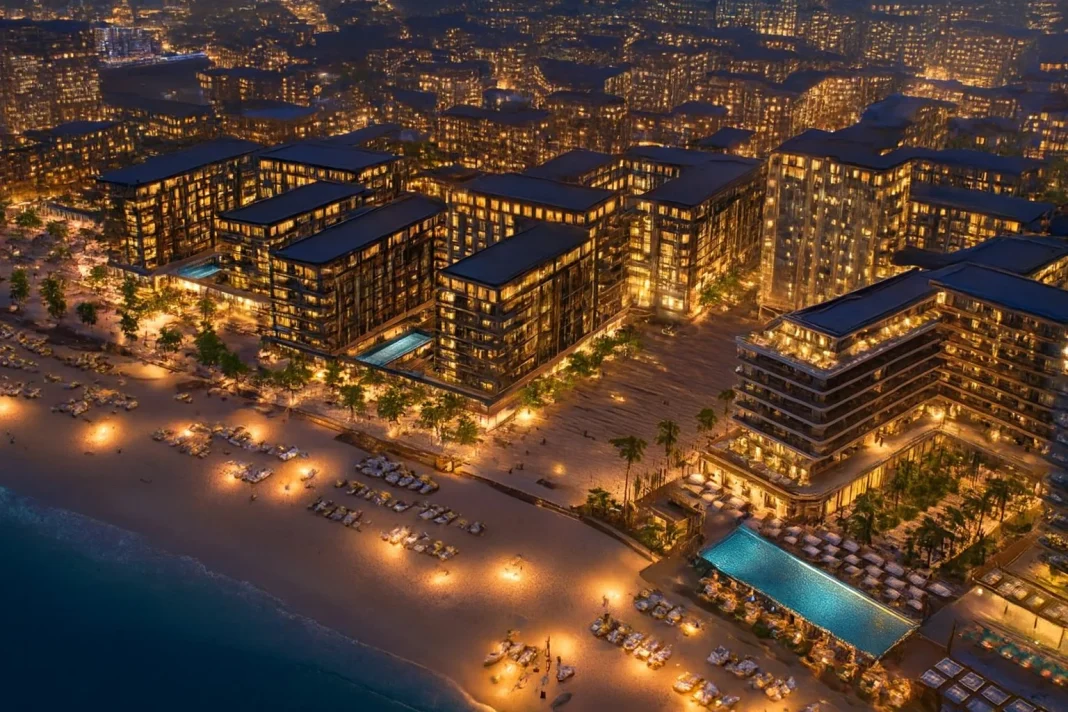
The project includes a 200-room Ritz-Carlton, a marina with capacity for 150 luxury boats and a 5,000-square-meter wellness center, infrastructures that generate recurring income and increase the residual value of the development. These operational components allow investors to capture rental income from tourism and ancillary services, diversifying sources of return beyond mere capital appreciation. For this reason, the financial model does not depend exclusively on the resale of units, but on an integrated ecosystem of revenue generation.