

The Sustainable City has become one of the most unique neighbourhoods in Dubai, designed for those who want to live better without giving up on the planet. This residential development occupies around 46 hectares in Dubailand, very close to Al Qudra Road and just a few minutes by car from Al Maktoum Airport, which gives it a strategic position within the emirate. It was born with the idea of proving that a more sustainable city is not only possible, but also profitable and comfortable.
The project was developed by Diamond Developers within the SEE Holding group, with construction starting in 2013 and finishing around 2016, which makes it one of the first communities of its kind in the region. Today it is presented as an integrated urban ecosystem, with efficient homes, productive green spaces, educational and sports services, and a design that prioritises soft mobility over private cars. All this fits with Dubai’s ambition to become a global benchmark in urban sustainability.
AN ECOLOGICAL OASIS IN THE MIDDLE OF THE DESERT
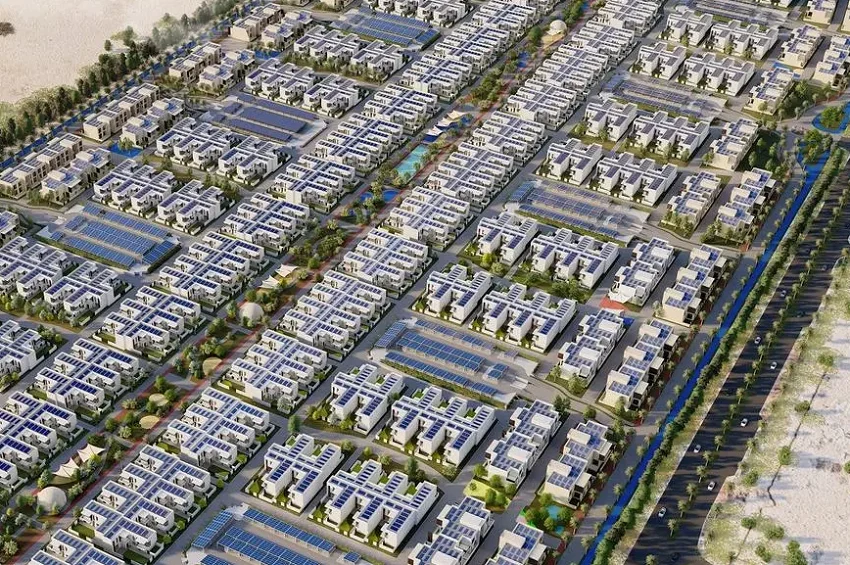
The Sustainable City rises over five million square feet, with a layout that combines villas, green areas, facilities and growing spaces to produce food locally. The design incorporates greenhouses, productive gardens and urban farming techniques that make it possible to cover a large part of residents’ caloric needs, reducing dependence on products transported over long distances. In this way, every available metre is used with a clear objective: efficiency and self-sufficiency.
The central axis of the neighbourhood works like a large green spine, with lakes and canals fed by recycled water coming from the homes themselves. This system helps cool the environment, creates shaded areas and turns the common zone into a continuous meeting place for neighbours of all ages. Around it are parks, playgrounds and sports areas that reinforce the feeling of living in an oasis in the middle of the desert.
THE SUSTAINABLE CITY AS A MODEL FOR THE FUTURE
The community is regarded as the first fully integrated and eco-friendly development in the Middle East, which makes it a reference point when talking about the cities of the future. Its model is based on three clear pillars: reducing resource consumption, generating clean energy and creating a cohesive community that actively participates in neighbourhood life. This combination of technology and social fabric is key to its success.
The solutions implemented in The Sustainable City have been designed to be replicable in other parts of the world, not only in Dubai. From positive-energy buildings, capable of producing more electricity than they consume over their life cycle, to water management systems and environmental education programmes, everything has been conceived as a living laboratory of urban innovation. This is why it attracts delegations and experts looking for inspiration for future developments.
SOFT MOBILITY AND PEOPLE-CENTRED STREETS
One of the most striking features of the neighbourhood is that much of the residential area is practically car-free, prioritising walking and cycling. Parking spaces are concentrated in peripheral areas and the interior is reserved for shaded walkways, bike lanes and safe spaces for children, which reduces noise and improves air quality in the streets where everyday life takes place.
For internal trips and connections with other parts of Dubai, there are electric transport options such as internal buses and charging points for private vehicles that facilitate the shift towards cleaner mobility. On top of this, there are well-signposted routes for running or walking, which encourage residents to integrate physical activity into their daily routine without the need for major logistical efforts or long car journeys.
EFFICIENT HOMES THAT SAVE MONTH AFTER MONTH
The homes in The Sustainable City have been designed to maximise energy efficiency through good insulation, careful orientation, strategic use of shade and roofs equipped with solar panels. Thanks to this combination, households can significantly reduce electricity consumption compared with conventional homes in Dubai, with savings that in some cases reach up to 60% on energy bills. This strengthens its appeal for both residents and investors.
Water is another key point: all systems include low-flow taps and sanitary ware, as well as infrastructure to collect, treat and reuse wastewater for irrigation. This reduces pressure on water resources in a desert environment while keeping gardens and green areas in perfect condition. This comprehensive approach turns each home into a small piece of a large machine for environmental savings and resilience.
ACTIVE COMMUNITY, SERVICES AND NEIGHBOURHOOD LIFE
The project goes far beyond its buildings, as it integrates schools, nurseries, a centre dedicated to autism, sports facilities, swimming pools, football and basketball courts, as well as spaces for well-being and culture. This allows many daily needs to be covered within the neighbourhood itself, reinforcing the sense of closeness and reducing reliance on cars to access basic services or extracurricular activities.
Community life is supported by centres such as SEE Institute, focused on training and spreading knowledge about sustainability, and by facilities that foster encounters between neighbours, from shared gardens to pet parks. This network of spaces helps create bonds between residents with very different profiles, generating an active and collaborative social climate that is reflected in high occupancy and long-term residency rates.
WHY IT APPEALS TO SPANISH INVESTORS
From a real estate point of view, The Sustainable City is located in a fully authorised area for foreign buyers, which makes it easier for non-Emirati citizens to purchase freehold properties. The combination of a consolidated location, sustainable design and international recognition means that prices tend to show a positive evolution over time within Dubai’s market.
In addition, the community records strong rental demand thanks to its low operating costs, energy efficiency and the quality of its services, which translates into good occupancy rates and yields above the average of many traditional neighbourhoods. For a Spanish investor, this means combining a growing global trend, sustainable housing, with a dynamic market like Dubai and a residential concept that has already been tested.